Skip to content
← Showcase albums

Book of Voices - Volume 5

Can God still be found when everything familiar is gone?

Exilic sonic palette: hammered dulcimer/santur, low reed winds (ney, duduk), earthenware percussion, and glazed-brick reverb dominate throughout. The mix begins cavernous and sparse (V.1–V.5), contracts further into displacement (V.6–V.9), then cycles through defiance-heat (V.9–V.11), serene drone-space (V.12), comic-storm texture (V.13–V.14), Americana earthen tones (V.15–V.16), ash-heap rawness (V.17–V.18), and finally refills the room only partially (V.19–V.20). Jerusalem exists only as memory: harp figures bleed in as ghosts, stopping mid-phrase. No electric unless disguised as vision, furnace, or whirlwind. The second temple's acoustic space in V.20 is audibly smaller than Vol. IV's — that diminishment IS the final statement. Key palette rotates: B Phrygian · E Hijaz · G Dorian · C♯ minor · D minor (Cell carriers only). No key on more than 7 tracks. Motif cells by code only: W, B, R, N, K, L.

20 tracksone concept · one palette
Read it as a song-novel →
Book of Voices - Volume 5 Radio00 / 20

Loading…

0:00
0:00

Space play/pause · ← → seek 5s · J/L seek 10s · M mute · N/P next/prev
01 · Male vocalChoral art-song / chamber folk
Here Am I, Send Me cover art

Here Am I, Send Me

The year the king died, I entered the temple
not to prophesy —
to grieve.
The smoke was already there.
I did not bring it.
Robes filled every corridor —
the hem of something I had no word for.
The doorposts flinched.
Not the way stone flinches in an earthquake.
The way stone flinches when it has no language
for what has struck it.
Above me: fire that had faces.
Each covered what it was —
two wings across the eyes,
two at the feet,
two for the motion that wasn't flight
but something flight has always been a shadow of.
And they were calling.
Not to me.
To each other.
To the room itself.
Holy.
Holy.
Holy is the LORD of hosts —
the whole earth is full of His glory.
The whole earth, already full,
and I had not seen it till that hour.
I am ruined.
Not afraid — ruined.
There is a difference.
Fear has a future.
This has no future in it —
only the present tense of what I am:
a man with unclean lips
standing where lips were never meant to stand.
My people carry the same.
I did not arrive here separate from them.
I walked in to grieve a king
and found I was the thing that needed grief.
Then one of them peeled away from the rest —
not gently —
with a stone pulled from the fire,
a coal that had been burning
since my people first learned to sin.
It touched my mouth.
Not the room where I stood trembling. Not my eyes.
My mouth —
the instrument of what I had already said
and what I had not yet been asked to say.
The guilt is lifted.
The wrong is covered.
I stood there.
Upright.
Which surprised me.
Then the burning.
Not from a direction.
From the room.
Whom shall I send?
Who will go for us?
And the question opened —
the question did not finish —
I said:
Here am I.
Send me.
The full commission arrived then,
and I will say it plainly:
Go.
And make this people's hearing heavy.
Make their eyes dim.
Until the cities empty
and the land stands utterly forsaken
and I have moved what remains far off.
I stood in the smoke
with the coal warm against my lips.
I had raised my hand
before the cost had been spoken.
I had already said yes.

Make this in Suno

Choral art-song chamber folk, through-composed, no repeating chorus. Male lyric tenor, court-trained register, half-spoken delivery in Pillar II coal scene, speech-song in Pillar III commission sequence, full-voice on each Trisagion cry. Sparse santur and hammered dulcimer, low ney reed wind sustaining throughout, earthenware percussion entering only at threshold-crack moments, glazed-brick cavernous reverb with long decay, no electric instrumentation. Three isolated choral texture moments on the Trisagion cries — the only choral presence in the volume — each cry followed by silence before the next. Production density: very sparse, 0.65 intensity, cavernous and exposed. Jerusalem harp figure bleeds in as ghost at 'the year the earthly king was buried,' stopping mid-phrase. Tempo slow and irregular, following speech-song breath groups rather than fixed pulse. B Phrygian modal center.

Paste the style into Suno’s style field and the lyrics above into the lyrics box — the section markers and performance directives are Suno-ready.
02 · Male vocalProphetic ballad / dark folk
Man of Sorrows cover art

Man of Sorrows

They sent me to tell you what I have seen.
I am working on the words.
I saw him listing — not falling — listing
the way a man lists when the gravity pulls wrong for him.
The moth kept circling the clay lamp; I watched the moth.
My shoulders locked and I could not look away.
Refrain I
I set the stylus down.
I could not write the word.
I saw his back — the furrows opened there,
deep as a field no one planted, no one claimed.
Pierced through for what was mine to carry —
I have written that line twelve times.
It will not hold.
Refrain II
I set the stylus down.
I cannot write the word.
I saw the wound close over — watched the welt go soft —
the tearing and the mending one motion, one instant.
Those words fouled me — I could not swallow them or set them free.
He was ruined for what I was.
I do not know what to do with that.
Refrain III
I lifted the stylus.
I pressed it against the clay.
Bridge
Forty years from that night, a student pressed my arm
and asked me what I'd meant by wound and mending in one motion.
My jaw locked.
I was in the room with the lamp.
I was watching the moth.
I saw him turn.
The face — I cannot —
He was looking at me the way a wound looks at the man who made it.
I am the man the vision chose, and I cannot tell you what the vision showed.
Refrain IV
I set the stylus down.
The lamp is cold.
The moth is —

Make this in Suno

Prophetic dark folk ballad, ancient Near Eastern setting, sparse and cavernous mix. Male court tenor vocal, authoritative and precise in strophes, increasingly halting at refrains, jaw-locked compression at bridge, near-spoken final section. Bare unharmonized cello as sole melodic instrument, exposed and without harmonic support. Ney reed drone sustaining beneath, low and mournful. Earthenware percussion near-absent, only a single low strike at each strophe opening. Glazed-brick reverb, long decay, the room feels like a stone writing chamber. No electric instruments. Ghost harp figure bleeding in at bridge, stopping mid-phrase before the forty-years time jump. BPM approximately 52, rubato in final strophe. Key: E Hijaz, modal, no resolution at cadence points. Dynamic arc: begins in controlled half-voice, tightens through strophes II and III, stalls completely at Refrain III

Paste the style into Suno’s style field and the lyrics above into the lyrics box — the section markers and performance directives are Suno-ready.
03 · Male vocalAnguished folk-rock
Fire in My Bones cover art

Fire in My Bones

Pashhur dragged me to the stocks — I know his face now
I know what mockery sounds like from a priest
I swore this morning at the gate: these lips are finished
Let the word of God go break some other man and feast
I press both fists into my ribs — it pries them open
I said I'm finished
I am finished
Watch me — I am finished
But the fire won't lie down, the fire won't wait
It pries me open — I can't seal the gate
I swore on my raw wrists I was done
But the oracle's already in my mouth
Cursed be the man who told my father: son
Let that day be swallowed, let it go unborn
I speak and every friend I have becomes a hunter
I open up my mouth and find myself alone and torn
I've been a joke in every gatehouse in Jerusalem
They watch me and they wait for me to fall
But the fire —
The fire —
The fire won't cage at all
The fire won't lie down, the fire won't wait
It pries me open — I can't seal the gate
I swore on my raw wrists I was done
But the oracle's already in my mouth
Here is the count:
Sealed my mouth at dawn — it broke before the market opened
Sat two days without speaking — spoke on the second morning
Swore on the wrists Pashhur marked — spoke before the bruises set
This is the fourth time I have promised myself
The fire is not His only — it is mine
I hate that I have carried it this long
There is no God-shaped wall that anchors this burning
There is no way to separate the fire from the song
I will not —
I cannot —
The fire won't lie down, the fire won't wait
It pries me open — I can't seal the gate
I swore on my raw wrists I was done
But the oracle's already in my mouth
The Lord is fierce and mighty — He will fight
And I —
I will sing

Make this in Suno

Anguished folk-rock, raw acoustic intensity, ancient Near Eastern undertones filtered through American roots urgency. Male raw high baritone, dry close-mic delivery, near-speech recitative sections erupting into full-voiced folk declarations. No reverb — suffocating proximity, the voice in the room with you. Driven acoustic guitar with hard rhythmic attack on ARIA sections, frame drum locked to pulse, no ornamentation. ARIOSO bridge strips to single hammered dulcimer figure, near-silence, cold and measured. Santur texture bleeds in at RECITATIVE II collapse points. Earthenware percussion underlies the arias like a heartbeat being forced. E Hijaz modal coloring, minor tonality, no resolution in the harmonic language. Tempo driven and urgent in recitatives, slightly held-back in arias to let the voice carry. Dynamic arc: verse sections compressed and intimate, arias explosive

Paste the style into Suno’s style field and the lyrics above into the lyrics box — the section markers and performance directives are Suno-ready.
04 · Male vocalEarthen folk
The Potter's House cover art

The Potter's House

He throws the clay at dawn before he speaks,
slaps it flat and centers it by palm,
the wheel grinds on under his bare feet
while the lump finds its place and anchors its form.
I stood against the wall and watched him work,
watched his thumbs press in and pull the walls up thin,
a morning's worth of shaping in the workshop light—
and then he pressed his thumb and caved it in.
The wheel kept turning. He did not stop the wheel.
He slapped the ruins flat and worked them in,
scored the surface with two fingers, reading the texture—
and the vessel rose again from what had been.
I have stood in the ash of what I said would burn
and found that standing was the wrong word for it.
I never saw the sermon in a ruin
until I watched him open what he'd scarred.
Ruined is not finished — only ready.
That is the thing the potter's wrists declare.
He scores the flaw until the center locks,
he lifts the walls and reads the thinning there.
He cannot raise what he will not first press down —
he pressed his thumb through the lip of the finished jar
and the morning's work folded back to gray,
and the wheel kept turning where the ruins are.
The sun moved off the wall. He didn't notice.
He sealed the rim with one thumb, slow and sure,
pulled a vessel up from what was gray waste—
not restored, but different. Something more.
Then the word came, quiet, from behind my ribs:
As the clay is in the potter's hand,
so are you in Mine, O house of Israel.
Cannot I do with you as this man does?
I walked out of that house not knowing what I'd say,
not knowing what to ask or what to name.
Above the potter's house, the sky was wide
and did not explain itself. And yet I came.

Make this in Suno

Earthen folk ballad, G Dorian modal, slow to mid-tempo (52–58 BPM), male raw high baritone, half-spoken rhythmic verse delivery transitioning to sustained melodic lines at emotional peaks, intimate and austere. Lead instrument: santur or hammered dulcimer cycling in a repeating wheel-rhythm figure, slightly hypnotic. Secondary: low ney or duduk reed wind entering at Strophe III, mournful and breathy. Earthenware hand drum providing sparse pulse, never aggressive. Glazed-brick reverb, cavernous but dry — the acoustic space of a stone workshop, not a cathedral. No electric instruments. No strings. Bass register supplied by low frame drum and earthenware struck bowl. Production is sparse and centered: the vocal sits close-miked, the santur slightly recessed as if heard from another room. The wheel-rhythm figure never fully resolves — it loops through the final bars as the vocal ends

Paste the style into Suno’s style field and the lyrics above into the lyrics box — the section markers and performance directives are Suno-ready.
05 · Female vocalExile lament / psalm-song
By the Rivers of Babylon cover art

By the Rivers of Babylon

My mother's thumbs wore grooves into this cedar —
thirty years of festival, of first-fruit, of dawn.
I can feel where she pressed.
The willow holds what I cannot.
They said: Sing us one of the songs of Zion.
How shall we sing the LORD's song
in a strange land?
I folded.
Not silence out of strength —
I folded because I do not know where the song goes
when there is no smoke to carry it.
They measured my voice at twelve against the Levite scale —
not my voice.
My mother's voice, inherited.
Thirty years I sang what was already hers.
My thumb finds the cedar,
finds the groove she left,
and closes.
By these waters I sat down. I wept
when I remembered Zion.
By these waters I will not sing.
Not for their festival. Not for their gods.
Not for the guards who stand at the bank
and call our grief a performance.
The guild set each note against the altar —
every interval measured to the smoke,
every pause a vessel for what rose.
Without the altar, the pause is just a woman
waiting in foreign mud for something to answer.
I have hung you, harp, on this willow.
I will not take you down.
If I forget you, O Jerusalem —
let my right hand forget
what it spent thirty years learning.
Here is what I would not say before —
I was afraid the song would rise.
Not into silence.
Into attendance.
His presence, needing no altar,
no cedar, no smoke, no guild singer
kneeling in the mud by a canal in Babylon —
and the silence I have kept
would be proved
not grief
but fear of being found
still singing
after everything
that told me where He lived
had gone.
I sat by these waters.
I did not sing.
The harp
is still on the willow.

Make this in Suno

Exilic art song, through-composed psalm form, solo female mezzo-soprano, speech-song register with periodic drops to near-whisper, no vibrato on grief passages, voice disciplined and restrained, harp fragments (acoustic, gut-string) that interrupt mid-phrase and stop unresolved, D minor tonality, B Phrygian modal inflection, glazed-brick room reverb — cavernous and sparse, maximum space between notes, low reed wind (duduk) entering only at the Strophe IV peak then withdrawing, earthenware frame drum at rest for entire song except one struck beat at the coda's opening line, hammered dulcimer/santur ghost tones beneath the harp fragments, BPM approximately 52 — unmeasured, rubato, psalm-speech rhythm, dynamic arc from restrained (Strophe I) to sealed silence (Strophe II refrain) to flat enumeration (Interlude) to barely voiced coda, no percussion except the single earthenware strike

Paste the style into Suno’s style field and the lyrics above into the lyrics box — the section markers and performance directives are Suno-ready.

06 · Male vocalVisionary psych-rock / E Hijaz drone
Wheels Within Wheels cover art

Wheels Within Wheels

The thirtieth year, the fourth month, the fifth day —
I was standing at the Chebar with the others
when the sky above the north
did not open so much as reveal
it had never been closed.
A wind split the north open —
enormous and bright —
four faces in one body:
man, lion, ox, eagle,
moving without turning,
going wherever the spirit moved.
And I was the only afraid thing there.
Beneath the creatures, wheels —
each one inside another,
high and terrible,
full of eyes —
all around the rim —
and when they rose, the creatures rose,
and their roar
shook the Chebar like it had never shaken before.
And I was the only afraid thing there.
Above the creatures, an expanse
the color of polished ice —
and above the expanse, a throne,
and above the throne, a form like a man
burning from the waist up,
burning from the waist down —
the appearance of the likeness
of the glory of the LORD —
and the Chebar at my feet
had never been so small.
And I was the only afraid thing there.
He gave me a scroll to eat.
I had prepared my tongue for ash.
It tasted like honey.
That was the worst part.
I stood.
The scroll sweet on my tongue.
I walked to Tel-Abib
and sat among my people seven days
and said nothing —
because there was nothing yet to say,
and the vision did not explain itself,
and I did not ask it to.
Coda
I was the only afraid thing there.
The wheels were not afraid.
The faces were not afraid.
The fire above the expanse was not afraid.
Only me —
face-down in the mud at Chebar —
the only thing
small enough to break.

Make this in Suno

Visionary psych-rock, E Hijaz modal drone, ancient Near Eastern exilic soundscape, intense mid-tenor male vocal in shifting speech-to-song spectrum, hammered dulcimer and santur in dense layered ostinato (wheels-within-wheels texture), low reed choir of ney and duduk entering on vision sequences, dissonant overtone stacking on fire and figure passages, glazed-brick reverb with long metallic tail and no decay resolution, earthenware frame-drum percussion sparse and ceremonial, no electric guitar unless disguised as overtone wash, no Western harmonic resolution, modal suspension throughout, slow processional tempo 52-58 BPM, dynamic arc from stunned recitative whisper-edge to full-voiced scroll peak to stripped seven-day silence to face-down spent finale, vision-catalog strophic form with no chorus return, atmosphere of annihilating holiness and priestly undoing

Paste the style into Suno’s style field and the lyrics above into the lyrics box — the section markers and performance directives are Suno-ready.
07 · Male vocalRattling gospel-stomp / G Dorian
Can These Bones Live cover art

Can These Bones Live

He sets me down on the valley floor.
I wade among the bones — every one.
All of them dry. All of them far from any man.
All of them Israel.
Son of man — can these bones live?
Lord God — you know.
I speak what He put in my mouth
to what never had one.
Dry bones, hear the word of the Lord:
I will lay sinew over your ruin.
I will bring you up from the open ground.
I will wake you wide awake.
And you will know — you will know —
that I am the Lord.
And I am speaking
when the valley starts to shake.
Rattle, rattle — rise.
Bone to bone across this valley wide.
Breath of God, come fill the dark inside.
Rattle, rattle — rise.
Bone finds its brother in the dark.
Sinew pulls across the ruin.
The valley fills with standing shapes —
but no pulse yet.
Just the frame of men.
Rattle, rattle — rise.
Bone to bone across this valley wide.
Breath of God, come fill the dark inside.
Rattle, rattle — rise.
I call out north. I call out south.
I call out east and west —
Come, breath, from the four winds.
The valley fills
with what I didn't know I held in my chest.
And they stand.
I count one man.
Then ten.
Then I stop counting.
Rattle, rattle — rise.
Bone to bone across this valley wide.
Breath of God, come fill the dark inside.
Rattle, rattle — rise.

Make this in Suno

Rattling gospel-stomp in G Dorian, exilic Near Eastern instrumentation with full-body percussion surge. Male intense mid-tenor vocal, priest-prophet register, moves from half-spoken awe through commanded full-voice prophecy into explosive shout-choir call-and-response. Frame drums (daf, riq) drive the backbone with heavy stomping pulse at approximately 96 BPM. Bass oud provides low tonal drone and rhythmic punctuation. Shawm or zurna enters at the RATTLING section for piercing upper-register texture. Earthenware hand percussion layers through the stomp sections. Glazed-brick reverb gives the valley its acoustic expanse — wide and flat, not cathedral-deep. QUESTION section: near-silence, single bass oud note sustaining under spoken-sung voice. PROPHECY: frame drums enter, bass oud rhythmic, voice at full command. RATTLING: full-stomp detonation, all percussion

Paste the style into Suno’s style field and the lyrics above into the lyrics box — the section markers and performance directives are Suno-ready.
08 · Male vocalChamber-suspense / B Phrygian
The Dream and the Statue cover art

The Dream and the Statue

The rooftop carries us like a cupped palm —
three men behind me, silent as the canal.
I count the stars to keep from counting
what morning owes the captain of the guard.
Revealer of mysteries —
You who set the ages in their sequence —
the wise men of Babylon are sleeping their last sleep
unless You open what You sealed.
I am not afraid of the king.
I am afraid the sky will say nothing.
So speak into the dark, then.
I will carry what You give.
I stood before him and I said:
there is a God in heaven who reveals mysteries —
and He has shown the king what will be.
You showed him this:
a figure vast as the horizon —
dazzling — and terrible —
gold head catching the torchlight of ten thousand years,
silver chest and arms, bronze belly,
legs of iron that have never buckled,
and at the feet — clay.
Not gold. Not bronze. Not iron.
Clay — the same clay these walls are made of,
the same clay the canal banks are made of —
fragile.
He dreamed of his own empire
and did not see his feet.
Gold passes to silver passes to bronze
passes to iron — each age
diminishing in luster, hardening —
until the last thing standing
is also the most fragile.
I told him the gold was his,
and the clay was his,
and the clay was the end of it.
Then something came down from the mountain.
Not from a quarry. Not from a craftsman's shed.
No hand selected it. No chisel shaped it.
It simply descended —
and struck the feet,
and the whole vast structure dissolved:
gold, silver, bronze, iron, clay —
all of it at once,
like a threshing floor swept at harvest
until there was nothing left to find.
And the stone became a mountain
filling the earth —
all of it —
until there was nothing else to fill.
This is what I spoke into the morning.
Not comfort. Not flattery.
The truth the sky gave back in the dark
when I asked it to speak
and it did.
The dream is certain.
The interpretation sure.

Make this in Suno

Sacred classical song-novel entry, Track 8 of 20. Male young baritone, half-spoken recitative opening into full-pitched aria, closing in intimate arioso. Chamber trio: hammered santur marking the statue inventory's descending metals with percussive precision, low ney reed holding a sustained B Phrygian drone beneath the night-prayer sections, single earthenware frame drum providing slow heartbeat pulse. Glazed-brick reverb — not cathedral, not intimate — the acoustic of a borrowed stone room in Babylon. No strings. No electric. Production begins at near-silence for the recitative, swells through the aria as each empire is named, then drops sharply for the arioso confession before the doxology opens the room slightly. BPM approximately 54, rubato throughout. Key: B Phrygian. The final three 'even' lines are sung quietly at near-speech volume, not triumphantly — the room does not fill

Paste the style into Suno’s style field and the lyrics above into the lyrics box — the section markers and performance directives are Suno-ready.
09 · Male vocalDefiance anthem / C♯ minor furnace-rock
But If Not cover art

But If Not

Hear the king's command upon the plain of Dura:
when the horn sounds, when the reed begins,
every nation, every tongue falls level —
bow before the gold raised to heaven.
Whoever will not fall, the furnace waits.
Whoever will not kneel, the fire.
They called me Shadrach when they crossed me off their lists —
wrote it on a tablet, pressed a seal in wax.
But the name my mother breathed across my forehead
doesn't live in any record Babylon has.
A seal is not a name.
It's what they use when they don't know your name.
We answered him with level voices:
our God whom we serve is able
to deliver us from the burning furnace —
and He will deliver us from your hand, O king.
But if not — be it known to you —
we will not serve your gods.
We will not bow to the gold you raised.
Not this fire —
not this king, not this gold.
We stood planted while the plain went flat.
Seven times hotter — we heard him. We will not bow.
Not this fire.
The fire only burned the rope.
The soldiers at the door —
they threw us in and didn't make it back.
The heat took them at the threshold.
We were already past that.
A fourth shape in the smoke —
nobody filed him, nobody assigned him.
The king rose off his throne:
Did we not cast three men, bound?
I see four — loose, walking in the fire —
and the fourth is like a son of the gods.
He walked between us like a man
who knew exactly what our names were.
Not this fire —
not this king, not this gold.
We stepped out while the king forgot to speak.
No rope on us, no singe, no smoke on what we wore.
Not this fire.
The empire had our names —
it never had the ones that mattered.
Coda
Mishael. Azariah.
Hananiah.

Make this in Suno

Defiance anthem, hard rock, biblical reframe, C-sharp minor, furnace-rock intensity, distorted santur functioning as both fire and vision texture, heavy earthenware percussion driving the verse rhythm, low reed winds (duduk and ney) threading underneath the King's Terms section in half-speech register, glazed-brick reverb on the full-band chorus, seven-fold percussion hit marking the Furnace section entry, male defiant young tenor — full chest voice on the chorus belting open vowels, rhythmic half-speech on the King's Terms verses, stunned witness-register on the Furnace bridge dropping to near-speech, then returning to flat declarative full voice on the Coda, no electric guitar unless disguised as vision or fire, Cell N downward figure on distorted santur entering at the fourth-figure moment only, BPM approximately 96 driving the declarative pulse

Paste the style into Suno’s style field and the lyrics above into the lyrics box — the section markers and performance directives are Suno-ready.
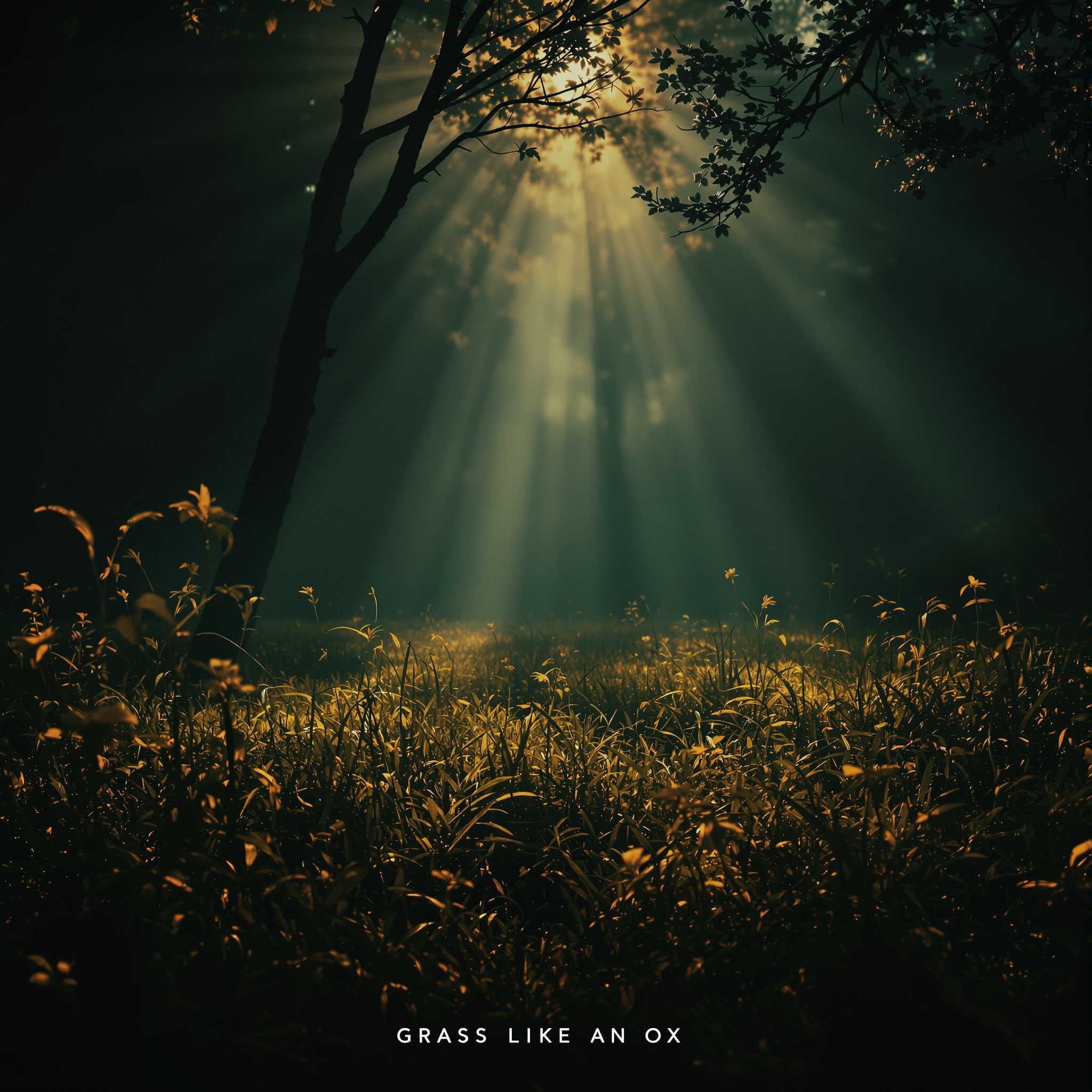
10 · Male vocalImperial art-rock / E Hijaz
Grass Like an Ox cover art

Grass Like an Ox

His dominion lasts
When all my dominion
Turns to dew
His kingdom — no end
Mine ended
And that was the mercy
I raised the Ishtar Gate
Lapis and lion, tier on tier
And the Most High
Did not blink
I walked to the roof of my palace
I opened my mouth and I said:
Is not this Babylon, the great —
Is not this the house that I —
And the breath arrived
Before I finished
Seven seasons I walked without a name
My hair grew long as eagle feathers
These hands — I will not call them hands —
grew hard as claws
The Euphrates ran past me every morning
I did not redirect it
I had never redirected it
The dew found me in the dark
I could not refuse it
My skin forgot it was a king's skin
I ate what the field offered
I was grateful
Because gratitude
Was all the grammar I had left
Then —
Not yet the throne
Not yet the name
Just this:
I opened my eyes upward
One motion — no plan behind it
The way a man in deep water
Stops and looks up
My understanding walked back in
Like a servant who had been waiting
In the hall the whole time
Bridge
The scribes are at their tablets now
The glazed brick catches the morning light
Same court. Same seals. Same wax
There is no decree for this
The throne fits the same
His dominion lasts
When all my dominion
Turns to dew
He gave it back —
The name, the throne, the gate —
And I knew what it cost this time
Those who walk in pride
He is able to abase
I know
I was the grass
He let grow back

Make this in Suno

Imperial art-rock meets ancient Near Eastern liturgical testimony. Deep male imperial bass-baritone, near-spoken in the opening recitative against a low sustained duduk drone and hammered santur, deliberate and stentorian. Earthenware frame drum enters slowly in the aria section, low and irregular, animal in feel. E Hijaz modal tonality throughout — raised second creates the dissonance of empire. At the mid-track fracture all instruments drop to silence for two full measures before re-entering at half density. The doxology strips to single voice plus santur arpeggiation, then brass-adjacent duduk choir swells beneath the final declaration. Glazed-brick reverb on all elements — enormous room, ancient. BPM: 52-58 in recitative, slowing to 46 in the aria beast section, recovering to 60 in the doxology. Atmosphere: monumental, confessional, vast vertical space. Dynamic arc: grand opening

Paste the style into Suno’s style field and the lyrics above into the lyrics box — the section markers and performance directives are Suno-ready.
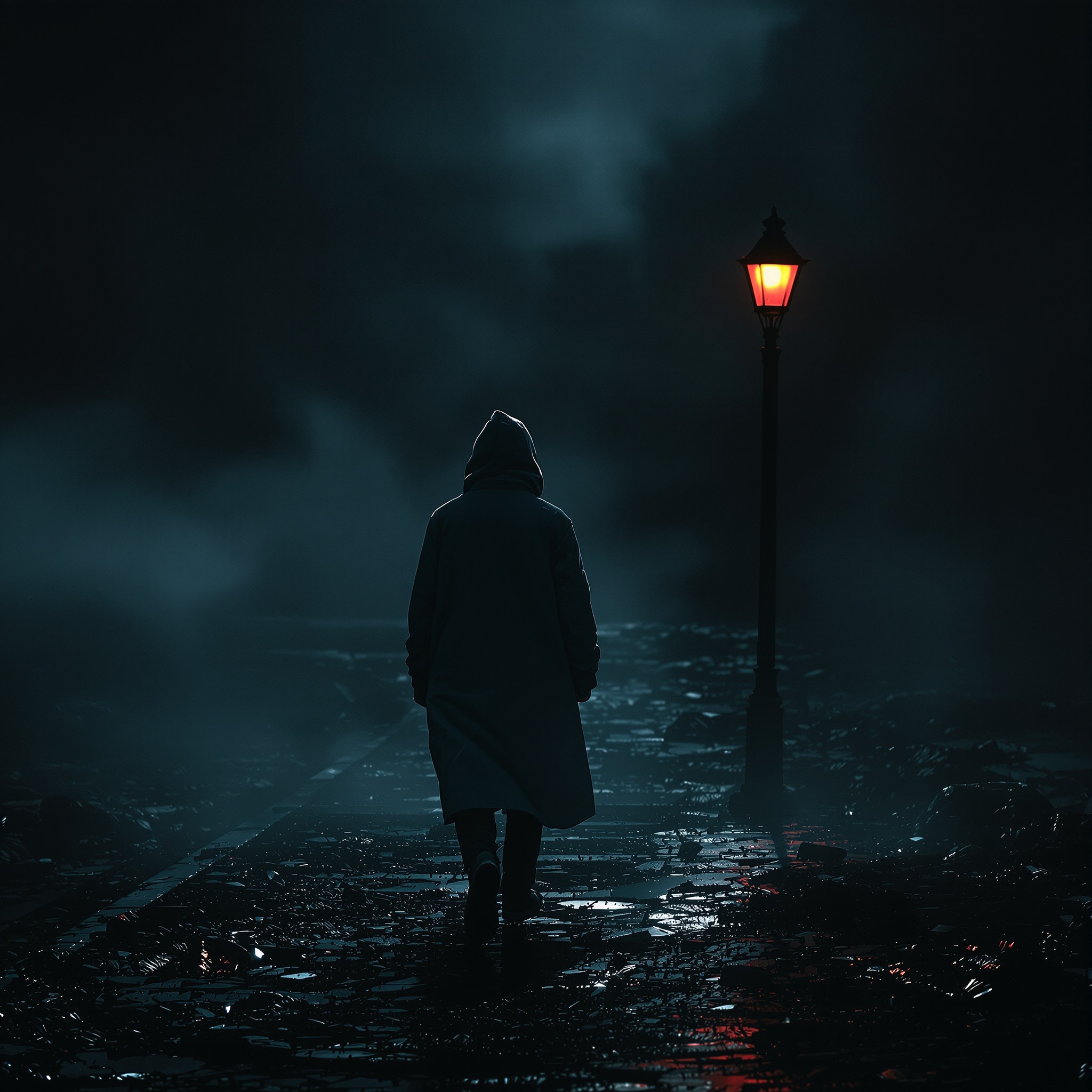
11 · Male vocalDecadent electro-swing (disguised as vision) / B Phrygian
Weighed and Found Wanting cover art

Weighed and Found Wanting

Torches on the glazed brick, a thousand men in silk
Bring me what they carried from the house they couldn't save
Gold and silver, let them pour for us tonight
I tilted the cup at heaven, and the torches shook
Chorus
Fill the cup, fill the cup again
Pour it to the ceiling, let the torches shake
Fill the cup, fill the cup again
One more round before the morning breaks
The music pressed the rafters, every lamp a little high
I said the God of Daniel had no reach this far inside
So pour another, let the Babylonian gods receive
What a dead king's temple held, and what a living king can seize
Chorus
Fill the cup, fill the cup again
Pour it to the ceiling, let the torches shake
Fill the cup, fill the cup again
One more round before the morning breaks
Then—
Plaster. White plaster.
A hand — no arm, no shoulder — knuckles glowing in the torchlight.
And the music —
Stopped.
My knees knocked together,
a king, alone in front of a wall.
I couldn't read it.
Nobody could read it.
I sent for someone.
Bridge
Mene —
Numbered.
Mene —
Numbered twice.
Tekel —
Weighed in the balances.
Found wanting.
Parsin —
Divided.
Someone else's name was in the cup.
The tally closed before I poured the last one.
The count ran through the gold, the silk, the hall.
All that the vessels ever held was holy,
and holy is a word I never learned at all.
Coda
That same night,
Babylon fell to the Medes.
And Belshazzar, king of the Chaldeans, was slain.
The cup remained full.
The torches burned down.
The name on the wall
still glowed.

Make this in Suno

Biblical operatic narrative, exilic Babylonian setting, decadent swing groove pivoting to cold recitative. Male light tenor vocal, swaggering and warm through the feast Aria, dropping to near-spoken flatness at the full stop, rising to fragile near-falsetto in the Arioso. Instrumentation: plucked santur and qanun mimicking brass swagger, syncopated frame drum and earthenware percussion driving the feast groove — then full dead stop mid-bar, silence, then cold solo ney alone for the Recitative. The Arioso brings one low drone, two plucked strings, and the voice only. Glazed-brick reverb throughout, deep and ceremonial in the feast, stripping to dry and close in the Recitative. Tempo: 126 BPM in feast groove, unmeasured in Recitative, 60 BPM in Arioso. Key: E Hijaz for the feast swing, modally ambiguous in Recitative, C-sharp minor for the Arioso.

Paste the style into Suno’s style field and the lyrics above into the lyrics box — the section markers and performance directives are Suno-ready.
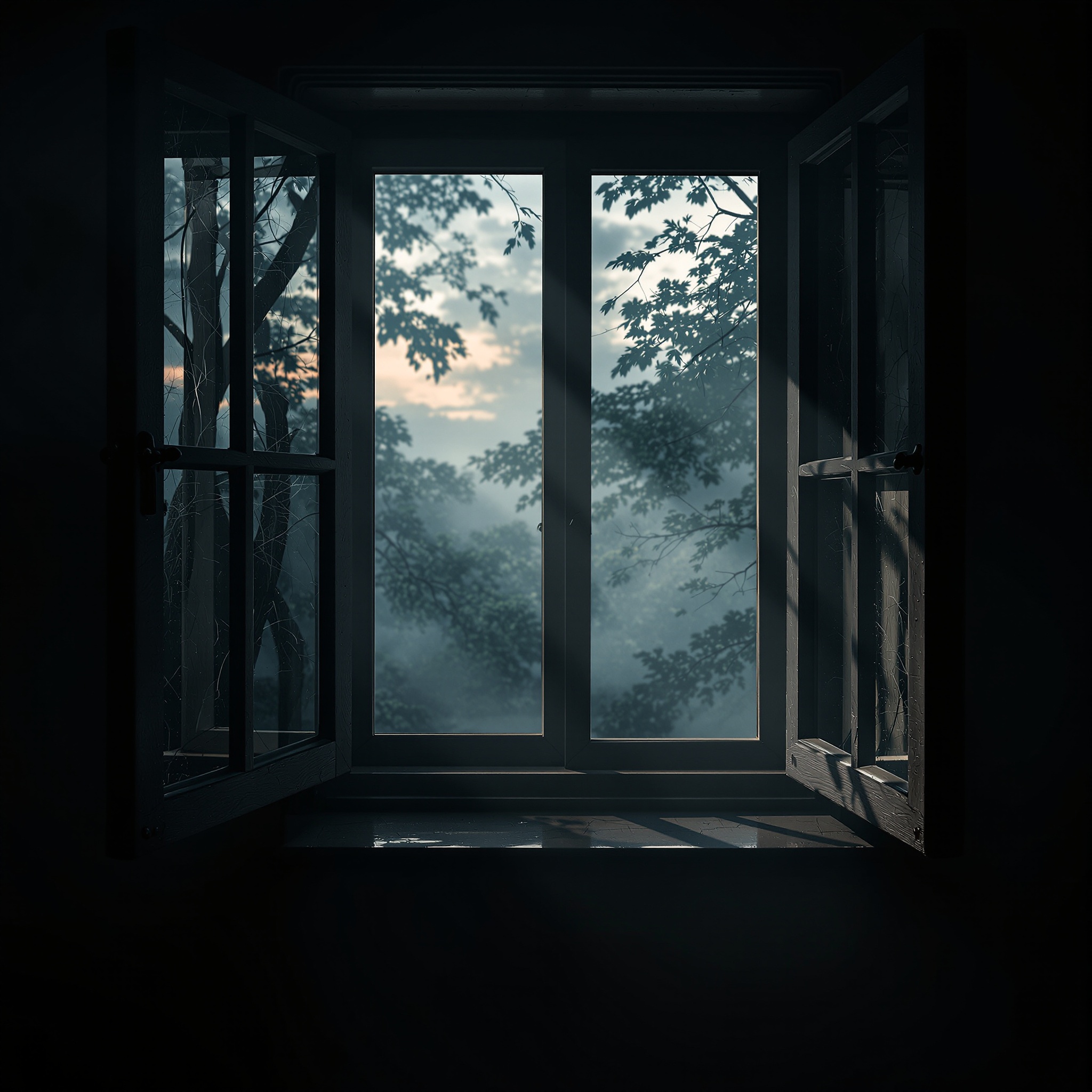
12 · Male vocalSerene faith-folk / G Dorian low drones
The Open Window cover art

The Open Window

The window opens east.
It has for forty years.
I press my forehead to the sill
and wait for what appears —
not the city,
it is ash and rain,
but I face the direction
and I kneel again.
Open toward nothing.
As he did aforetime.
The sun is straight above the dust.
I kneel again on stone.
My lips move through the words I know,
the ones I've shaped alone
in three kings' remnants,
through a night of fire,
through the feast that split the dark —
the kneeling does not tire.
Open toward nothing.
As he did aforetime.
When the reed birds settle on the water
and the river starts to dim,
I lean into the sill for the third time,
breathe across the rim.
Jerusalem sits in me
like a city getting small,
but I open toward the ash of it,
as I did before them all.
Open toward nothing.
As he did aforetime.
Bridge
He came to the stone at dawn
and called my name into the pit.
Darius. The empire's architect.
He could not sleep for it.
Daniel — did your God keep you?
He did. He sent His angel —
the mouths stayed shut all night.
And I was already on —
already at the east,
already at the dawn.
I had no proof to give him
but the callus on my knees.
He pulled the stone away himself
and wept into the freeze.
Open toward nothing.
As he did aforetime.
Open toward the ash of it.
Open toward the line
where the city used to be
before the fire came.
Open toward nothing.
The stone worn smooth where my knees go.

Make this in Suno

Serene faith-folk, G Dorian modal drone, exilic sacred music, ancient Near East sonic palette. Aged male baritone, serene and unhurried, conversational with melodic peaks on the refrain. Primary instrumentation: single bowed string (cello or viol) sustaining a low drone, hammered dulcimer or santur providing sparse melodic punctuation, minimal earthenware percussion entering only at the arioso. Glazed-brick reverb, long decay, intimate but cavernous. Tempo extremely slow — roughly 52 BPM, rubato. The mix is spacious and sparse, quieter than any track since Volume 2. No electric instrumentation. No drums in the arias. A ghost harp figure bleeds in once during the evening aria and does not complete its phrase. Production builds almost imperceptibly — the arioso adds the second string layer; the final aria lets it fall away again. Dynamic arc: intimate dawn opening, held midday weight

Paste the style into Suno’s style field and the lyrics above into the lyrics box — the section markers and performance directives are Suno-ready.
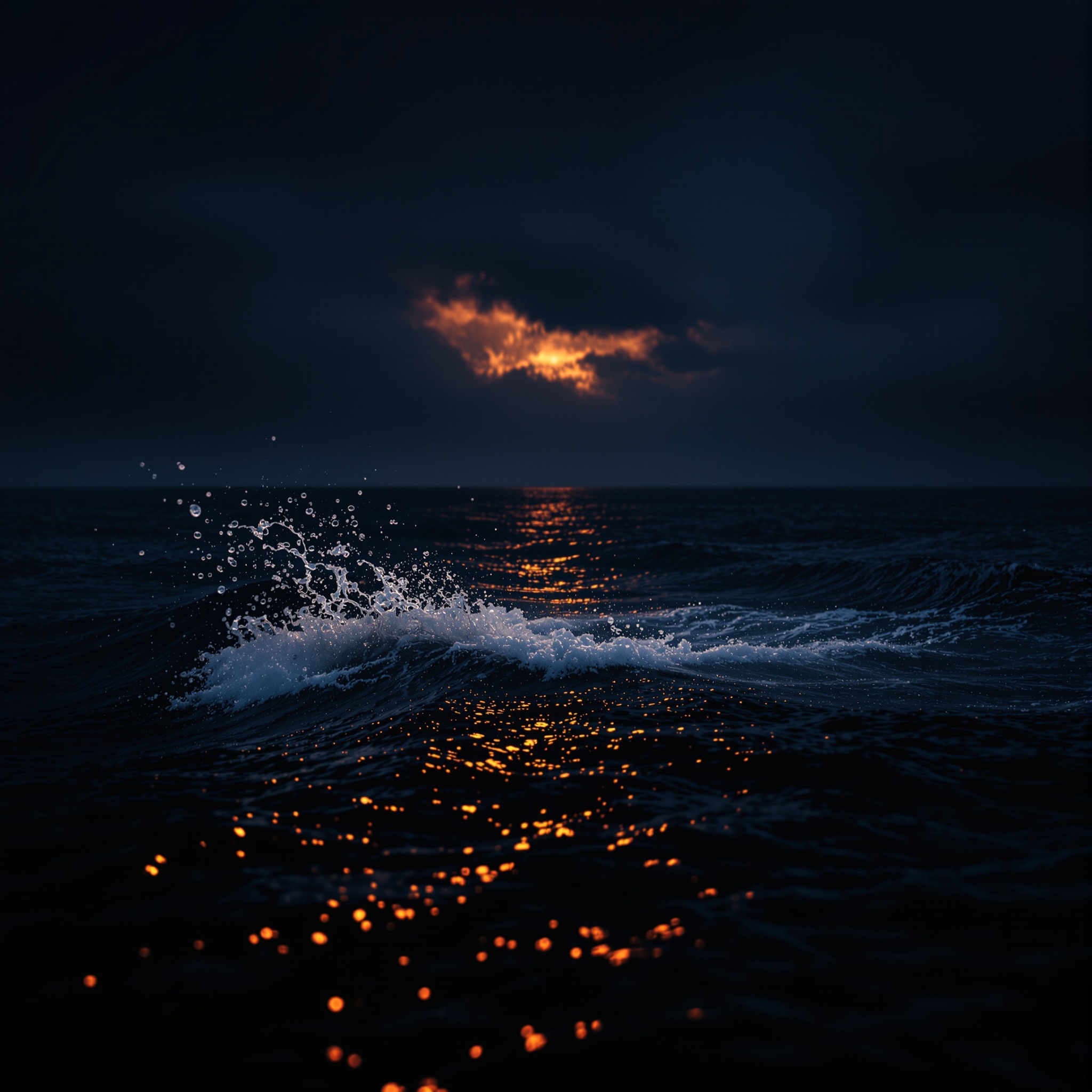
13 · Male vocalStorm-tossed sea shanty / D minor
Overboard cover art

Overboard

Verse 1
I paid my fare to Tarshish, pulled the plank up after me,
Found a corner in the hold and let the whole world be.
Sailors crying to their gods — every plank and pin —
I was sleeping like a man who'd made his mind up.
Heave, heave, what god is yours?
Who made the sea, who made the shores?
Cast the lot, let heaven choose —
The lot fell on the one who knew.
Verse 2
I said: Hebrew, prophet, worshipper of One
Who stretched the sea beneath us before He made the sun.
They looked at me the way you look at a man
Who ran from his own Maker in his own Maker's plan.
I said: take me up and throw me in —
the storm is mine; the sea will quiet then.
Heave, heave, what do we do?
The man himself said: throw him to —
They bent their oars for shore, they couldn't reach,
So overboard went one who ought to preach.
They cast lots. You understand what that means — they gave heaven a vote. And heaven, being heaven, voted for the one man on the ship who should have seen it coming. They were more afraid to throw me than I was to go. I don't tell that part often.
From the belly of Sheol I cried — and You were there already.
I thought the rules of place applied to You.
Your billows and Your waves — all of them — passed over me.
The seaweed wrapped around me, the water closed like shutters,
And You heard me — every gravel word I knew.
I went down to the roots where the mountains bolt the sea-floor,
To the place where the earth bars close for good —
And there You were.
Not waiting. Already there.
The fish was not my judgment.
The fish was my address.
Outro
Three days in the dark, and I composed a psalm.
I'm a hard man to place, but You are very calm.
When the fish set me on dry sand, I won't say I landed graceful —
But I was pointed the right direction, which I'm told is not the worst.

Make this in Suno

D minor folk shanty, comic gravel male baritone, half-spoken delivery in verses, full-song in choruses, near-spoken in interlude, psalm-register in bridge. Percussion-forward arrangement: stomping deck rhythm, earthenware handpan, struck wood, crew-stomp texture throughout. Plucked oud carries verse groove. Low ney reed wind enters only in fish-prayer bridge, sparse and mournful. No electric instruments. Glazed-brick reverb on the crew refrain to suggest open water and wooden hull resonance. BPM approximately 96, driving shanty pulse. Key of D minor. Verse energy is propulsive and playful, crew refrain is communal and comic, lot-casting interlude drops to near-spoken with rhythm suspended, fish-prayer bridge is sparse and quiet with ney drone, final verse returns to full stomp. Male vocal: gravel baritone, world-weary comic timing, dry delivery on the punchlines

Paste the style into Suno’s style field and the lyrics above into the lyrics box — the section markers and performance directives are Suno-ready.
14 · Male vocalWry desert-folk / G Dorian
The Vine and the Worm cover art

The Vine and the Worm

Forty days.
That's the whole sermon.
Forty days and Nineveh will be overthrown.
Eight words. I counted.
Eight words and the city fell to its knees —
the king took off his robe and sat in ash.
The cattle wore sackcloth.
I did not make that up.
Eight words. The most successful sermon ever preached.
I hated every second.
So I paid a fare to Tarshish — one way.
You don't run toward a God
who's going to change His mind.
But the fish had other plans,
so here I am east of Nineveh,
booth built, east wind coming,
waiting for the fire that never came.
He asked me: is it right for you to be angry?
I said: yes.
Obviously yes.
Then the plant came up.
Overnight — one night — full shade.
And I was not miserable.
I was grateful for the plant.
I loved the plant.
Then the worm came.
One worm, one bite, by dawn the plant was gone.
The east wind found me.
The sun pressed down.
I fainted and I asked to die again.
He asked: is it right to be angry —
about a plant?
I said: angry enough to die.
About a plant.
You grieve a plant you didn't plant —
a plant that came up in a night
and died in a night —
and I should not grieve
one hundred and twenty thousand people
who cannot tell their right hand from their left?
And also much cattle.
So here I am east of Nineveh.
The city is fine.
I assume the cattle have removed the sackcloth by now.
The plant is dead.
I am not dead — though I asked twice.
I grieve a plant.
He grieves a city.
One of us has the scale wrong.
You grieve a plant you didn't plant —
a plant that came and died inside one night —
and should I not spare Nineveh, that great city,
a hundred and twenty thousand souls
who cannot tell their right hand from their left —
and also much cattle?
He finished.
I haven't.

Make this in Suno

Wry desert-folk, G Dorian, dry acoustic recording, single oud carrying the melodic line with a sardonic descending figure that deflates slightly at each verse's end, quiet frame drum at half-tempo giving the groove a reluctant shuffle as if the rhythm itself doesn't want to be here, no electric instruments, earthenware room reverb — close and slightly hollow, like singing in a clay jar — male comic gravel baritone, mock-reasonable in verses and clipped-indignant in refrains, voice deliberately flattening to spoken recitation over a single sustained oud note in the coda, frame drum drops entirely before the coda and does not return, tempo around 88 BPM with a slight drag suggesting a man sitting in the sun with nothing to do but wait, sparse mix with significant silence between phrases

Paste the style into Suno’s style field and the lyrics above into the lyrics box — the section markers and performance directives are Suno-ready.
15 · Male vocalDevastating Americana / C♯ minor
Buy Her Back cover art

Buy Her Back

Lo-Ruhamah. Not Loved.
Three years old and already carrying the sentence.
Lo-Ammi. Not Mine.
I set that in their mouths like stone.
Fifteen shekels of silver —
I pressed them down on a stranger's cloth.
Homer of barley. Half a homer.
I didn't haggle. I couldn't.
Come.
You are mine.
I am yours.
Come.
The rope around her wrist was hemp.
I'd seen worse on goats at Jezreel.
She looked past me — not through me.
Past. Like I was a post in a field.
Gomer.
Gomer unchanged.
My mouth moved before the sound did.
As the LORD loves Israel in their worst.
How can I give you up? —
I have heard Him say it over Israel.
I said it over her.
Come.
You are mine.
I am yours.
Come.
Lo-Ruhamah.
Lo-Ammi.
Fifteen shekels.
Homer of barley.
Half a homer.
Three years old.
Gomer's weight.
Mine.
Go buy her —
as He buys you.
Go love her —
as He loves you.
And I understood —
I named them what God named us.
I thought it was the nation's grief.
I was not the prophet.
I was the ground.
Final Refrain
Come.
You are mine. I am yours.
I will betroth you to me forever.
Come.

Make this in Suno

Devastating Americana country ballad, C-sharp minor, aching male country tenor, conversational half-spoken verse delivery rising to full melodic grief in the refrain, sparse fingerpicked acoustic guitar doubled by bowed santur functioning as weeping pedal-steel analog, market-day ambient texture under the receipt verses — low earthenware percussion, distant animal sounds, dry room with zero reverb on verses, deep glazed-brick reverb blooming on the betrothal refrain, low ney reed wind sustaining under the refrain like a prayer underneath the words, 8-bar instrumental bridge with single bowed santur note decaying into silence, closing plea half-spoken over bare fingerpicked guitar, final 'come home' a cappella single note, no percussion, no bass, tempo approximately 58 BPM, ancient Near Eastern tonal palette filtered through Americana earthen warmth

Paste the style into Suno’s style field and the lyrics above into the lyrics box — the section markers and performance directives are Suno-ready.
16 · Female vocalCourage ballad / B Phrygian palace-undercurrent
For Such a Time as This cover art

For Such a Time as This

The letter came folded in linen —
Mordecai's hand, the words cut flat:
All our people. The decree goes out.
"If you keep silent now,
relief will rise for us from another place —
but you, and your father's house —"
"Who knows — who knows
if you were not placed here
for a time like this?"
I set the letter on the cedar.
I did not answer.
I asked for three days.
Three days, not eating. Not speaking.
My women beside me on the cold tile,
the palace going about its palace.
Someone ordered almond cakes for the king's table —
I heard the trays pass in the hall.
Do I go?
The law is not unknown.
Any woman uninvited —
the scepter extended or the floor.
One of those. That is all.
I asked the dark for something.
The dark stayed dark.
I went to sleep. I woke.
I asked again.
On the third morning, I rose.
I sealed myself into the royal robes —
the gold thread, the heaviness of what I carried in my chest:
orphan, ward, bride,
the people no one knew I held for three days.
The fear and the going
are not opposites.
I had learned that on the tile.
I arrived in the inner court.
The king looked up from his throne.
Across that distance —
all of it, the whole of how I got here —
he raised the scepter.
Gold.
If I perish, I perish.
I was already walking.

Make this in Suno

Biblical sacred folk, operatic recitative structure, female soprano lead vocal — near-spoken in verses, full melodic tone in aria sections, immovable stillness in chorus. B Phrygian modal tonality, plucked santur and hammered dulcimer in delicate rhythmic pulse, low ney flute threading beneath, earthenware hand percussion barely present — more felt than heard. Glazed-brick reverb, intimate but resonant. No electric instruments. No percussion climax. The power is in restraint: dynamics shift through vocal pressure alone, not band density. Tempo moderate and unhurried, 72–76 BPM. Verses half-spoken with minimal vibrato; chorus delivered with controlled soprano clarity, feet-planted, no ornamentation. Instrumental bridge 8 bars — santur solo, open and searching. Final arioso nearly a cappella, one plucked string beneath. Atmosphere: Persian court at dawn, stone tile, formal silence.

Paste the style into Suno’s style field and the lyrics above into the lyrics box — the section markers and performance directives are Suno-ready.
17 · Male vocalRaw ash-heap blues / E Hijaz
Though He Slay Me cover art

Though He Slay Me

Seven days you sat beside me and said nothing —
that was the only honest thing you brought.
Then Eliphaz opened up his mouth
and I heard the old logic come through:
the innocent do not perish.
I had seven sons.
I had three daughters.
Ask me again about the innocent.
I said it at the first grave:
the LORD gave. The LORD has taken away.
Blessed be the Name.
I still say it.
It costs more now.
You brought me a ledger.
You said: count your sins first,
then we will count your grief,
and the numbers will explain each other.
I have been counting.
The numbers do not explain each other.
The numbers are just numbers.
I am cutting my testimony into clay —
no court will call it, no judge will unseal it —
but I am cutting it.
I have nowhere else to put the truth.
Let me speak.
Let me speak.
Let me speak.
Bridge
She came to the edge of the ash heap.
She looked at what was left of me.
She said one sentence.
I heard it.
She was not wrong about the dying part.
But I —
though He slay me — though He is the one slaying —
yet will I trust Him.
And I will argue my ways to His face.
I know that my Redeemer lives.
I don't know how I know that —
it is not from the state of my skin,
not from the hush between the stars,
not from anything Eliphaz said —
but I know it.
After this skin is stripped from these bones
and I am standing in nothing,
I will see God.
With these eyes.
Not another's.
That is what this costs.
Everything.
Coda
Let me speak.

Make this in Suno

Ash-heap blues strophe form, solo male bass-baritone, shattered and controlled, rhythmic half-spoken delivery in verses tightening toward minimal sung pitch only on the final orientation phrase; no full-song vocal until the last four words; sparse world-folk instrumentation anchored by sustained low ney drone throughout, potsherd scraping texture as primary percussion (ceramic-on-ceramic, irregular, body-close), single hammered dulcimer or santur figure entering only in Strophe III and withdrawing; glazed-brick reverb, cavernous and dry simultaneously, close-mic bass-baritone with the room audible around it; E Hijaz modal palette, slow tempo, approximately 52 BPM, rubato in the incomplete lines; no electric instrumentation; the bridge drops to near-silence, only drone and ambient room, the vocal barely above speaking; final line held without accompaniment

Paste the style into Suno’s style field and the lyrics above into the lyrics box — the section markers and performance directives are Suno-ready.
18 · Male vocalAwe-struck orchestral folk / G Dorian whirlwind
Where Were You cover art

Where Were You

The wind pressed itself through the east without asking.
I heard it in the gravel first —
as stones shift when something larger moves through.
Then the sky opened and a breath
rode the storm to speak,
and I, who had been so full of argument,
pressed my lips and listened.
Where were you when I laid the foundations of the earth?
Tell me — since you seem to have the understanding.
Where were you when I spread the morning flat?
When the stars rang out together at the founding —
were you there to hear their shouting?
He showed me the Pleiades, sealed in their cluster —
seven lights I could not reach,
could not gather, could not hold.
He showed me Orion's belt, three stones hung
without a nail, without a hand to brace them —
and asked if I could loose them.
I could not.
He showed me the ostrich: how she leaves her eggs
in the warm dust and walks,
how she forgets what warmth belongs to,
yet when she spreads those ragged wings and runs
she outruns the horse, the rider,
the long shadow of the spear.
Who put that in her?
Not me.
He showed me the hawk finding south —
one tilt of a wing-tip, certain,
the way a man tips a cup when he knows it's full —
and I had no answer for that either.
He asked about the sea-beast that laughs at spears.
I had nothing.
Can you loose the morning star?
Can you bind the Pleiades?
Can you give the horse his thunder?
Can you teach the eagle where to nest,
or watch him mount the sky
and call him back?
And I —
who had prepared my case for weeks —
who had arranged the grievances in order —
I lay my hand on my mouth.
One word, and nothing more.
This is not the shape I thought an answer takes.
I thought justice would arrive like a ledger —
a finding read aloud, a line drawn under.
Instead He showed me wild things:
the rain that falls where no man walks or plants,
the lightning standing ready to be sent,
the mountain goat in her labor,
down and up and down, alone on the cliff,
and nobody watching but Him.
And somehow this is the answer.
Not what I asked for.
Something older than my asking.
I laid my argument beside me in the dust.
The egg rested there in the sand —
the ostrich gone, the morning warm above it —
and nobody explained the warmth to the egg.
The warmth was just there.
Coda
I had thought the empty room was all there was.
I had thought when the roof came down on my children
there was no place left on earth to meet Him.
But He was watching the goat labor on the cliff.
He was asking the morning star where to stand.
He was tracking the hawk on its long way south.
And I was on my ash heap
arguing with a ceiling
while He was in the open sky.
I had heard of You — the hearing of the ear.
Now my eye sees You.
I repent.
Not of the questions.
Of the smallness.
The morning stars sing out.
I just —
couldn't hear them from the ash.

Make this in Suno

Orchestral folk, biblical reframe, G Dorian, through-composed, slow ballad, 4/4, approximately 56 BPM. Male shattered bass-baritone vocal, speech-to-song spectrum: recitative sections delivered as cracked rhythmically-free speech, arioso as half-sung witness-tone, aria as full-throated vertical declaration, final whispered recitative near-silent with held pauses. Instrumentation builds from single bowed low string (cello or bowed santur) through hammered dulcimer entering at arioso, low reed wind (ney or duduk) entering at aria, earthenware frame drum in sparse pulse, full string ensemble swelling through the aria's catalog, then stripping to one voice and a single sustained cello chord for the final whisper. Glazed-brick reverb throughout, cavernous and expansive. No electric instruments. No percussion after the aria. The whirlwind is textural — low-frequency string swell

Paste the style into Suno’s style field and the lyrics above into the lyrics box — the section markers and performance directives are Suno-ready.
19 · Male vocalWall-building work anthem / D minor
A Trowel and a Sword cover art

A Trowel and a Sword

Four months ago I wept at Susa over a rumor of rubble.
Now mortar dries on my knuckles before I can wipe it —
Hanani counts the gaps from the scaffold, says nothing
The north face wants twelve more courses before dark
This is not the temple — this will have to do
Sanballat has sent his fourth letter this morning
The runner stands in the rubble below the wall
Come down to the plain — let us meet in the valley —
The runner goes back with the same word: not yet
Tobiah laughs from the rubble line:
a fox could walk that wall of yours and bring it down.
Let him laugh. The fox is not the one building.
The goldsmiths lay courses beside their own houses
The perfumer sets mortar with the back of his fist
The women fit stones against the gap in the Dung Gate
We are building what we sleep in — we cannot come down
They write it on papyrus: I am raising a king's road
Tobiah seals it, Geshem signs it, does not speak his claim to it
I could answer — I have written the answer already —
The runner goes back with the same word: not yet
Half the men hold spears while the other half build
One shoulder bent to the trowel, one turned toward the blade
The masons do not rest — they sleep in their clothes
No man among us takes off his sword for water
You have sent for me four times — I have not moved
You will not move me with a lie dressed as concern
The valley is where enemies invite you to be reasonable
I am doing a great work. I cannot come down.
Fifty-two days.
The rubble is sealed.
The nations look up and lose their laughter —
even they perceive this work was wrought of our God.
When the people wept at the reading of the word
we told them: do not weep. Eat the fat. Send portions.
The joy of the LORD is your strength.
I set the trowel.
I keep the sword.
Remember me, O my God —
for good.

Make this in Suno

D minor work-anthem, Biblical folk, CCM, world-ancient hybrid. Male baritone lead vocal — civil-servant composure, declarative and grounded, near-spoken in the bridge before returning to full chest voice in the final refrain. Instrumentation: alternating hand drum (dumbek, frame drum) carrying the trowel-rhythm pulse in verses; struck metal (anvil hits, clay-pot rim strikes) punctuating the refrains in sword-rhythm. Ney flute low in the mix, earthenware percussion, santur providing harmonic drone. Glazed-brick reverb, medium room, dry verses with opened reverb on refrain peaks. No electric instruments. BPM approximately 96, driving and purposeful. Builds from intimate and grounded in built-verses to declarative and percussive in refrains. Bridge drops to near-silence — one voice, almost spoken, minimal percussion — before the final refrain fills back with full hand-drum and struck metal.

Paste the style into Suno’s style field and the lyrics above into the lyrics box — the section markers and performance directives are Suno-ready.
20 · Male vocalBraided elegy / E Hijaz bleeding toward C major
The Old Men Wept cover art

The Old Men Wept

I was eleven when the cedar burned.
My father's shoulders could not hold the dark in —
I saw it through the smoke rising: the smoke rising
where the gilded walls had been.
The young men fling their arms into the sky.
A shout goes up that climbs each cut limestone —
they have not learned to hold a sound
and so it spills across the valley floor.
The old men beside me make no shout at all.
Their shoulders drop the way a man drops
when he has finally set something heavy
he carried forty years and does not know it yet.
I hear the Levites strike the response-call up —
the cymbals and the singing, the answer-phrase —
they raise it like a tent-peg
hammered into quarried Judean rock.
I remember a harp hung in the poplars
by the Chebar, thirty years ago —
the strings went slack in Babylon.
No one touched them. No one could.
And now the shouting and the weeping
rise into each other like two rivers
finding the same low place —
I hold my chest against my throat.
It moves.
Both things.
At once.
Bridge
I was eight years old in the outer courts.
The walls were too tall. The priests too far.
My sandal-strap broke on the pavement
and I sat down in the middle of the crowded court
and something reached me there — something
that did not need the cedar to arrive.
I was eight years old and already He was there.
I thought He lived in cedar.
He lived in this —
This smaller opening, this lesser height,
this quarried floor, this —
Is this the sound He wanted?
The young men shouting, the old men —
I hold my chest against my throat.
The smaller room — and He fills it.
I weep.
I rejoice.
I cannot tell you.
I cannot stop.

Make this in Suno

Sacred exilic folk, biblical reframe, male aged tenor vocal — warm cracked upper register, half-spoken recitative verses moving to involuntary full voice in final aria. Santur (hammered dulcimer) carries the joy-line in bright plucked attack; low ney reed carries the grief-line in sustained mid-register tone. Earthenware frame drum enters softly at convergence, not before. No electric instruments. Glazed-brick reverb throughout but compressed — the room is audibly smaller than the album's earlier tracks, that diminishment is structural. Two instruments begin alternating then gradually converge into simultaneous texture by the collapse section. BPM approximately 58, slow and ceremonial. Key: E Hijaz bleeding toward C major as joy-line brightens. Atmosphere: limestone quarry at late afternoon, the exposed foundation before any walls exist, open sky above. Sparse at opening

Paste the style into Suno’s style field and the lyrics above into the lyrics box — the section markers and performance directives are Suno-ready.