Skip to content
← Showcase albums

Book of Voices - Volume 6

The arrival everyone rehearsed for four hundred years happens in the wrong rooms.

Production Family: Stranger and exilic. Core palette: hammered santur, low reed winds (ney, duduk), frame drums, earthenware resonance, glazed-brick reverb — the emptiest mixes of the cycle. Jerusalem exists only as memory: harp figures bleed in as ghosts and stop mid-phrase (V.5). No electric unless disguised as vision (V.6), furnace (V.9), or whirlwind (V.18). Tracks V.1–V.5 establish the exilic void; V.6–V.9 fill it with strange fire; V.10–V.12 settle into Babylonian bureaucratic dread; V.13–V.14 open to the sea; V.15–V.16 move into desert and palace; V.17–V.18 strip to ash and storm; V.19–V.20 begin refilling the room — but the second temple's sound is audibly smaller than IV.10's, and the old men can hear the difference. Cell L bare and unharmonized throughout. Cell W displaced and unresolved. Cell N downward only. Cell R suspended at close. Cell B and K rest entire volume.

20 tracksone concept · one palette
Read it as a song-novel →
Book of Voices - Volume 6 Radio00 / 20

Loading…

0:00
0:00

Space play/pause · ← → seek 5s · J/L seek 10s · M mute · N/P next/prev
01 · Male vocalPriestly folk
Nine Months of Silence cover art

Nine Months of Silence

Intro
Ohhhh...
Ahhhhh...
Ohhhh...
Verse 1
Nine months of quiet, not chosen.
I could still hum. That was the mercy and the sentence:
you can grieve in vowels.
You cannot bless in them.
Blessing needs its consonants.
Kinnor rings at morning, I read lips.
My wife's face, full of light I cannot speak.
My hands shape prayers I cannot voice.
Verse 2
Eight days past.
Women press: call him Zechariah,
call him after his father.
Elizabeth shakes her head.
John — she says. John.
They press the tablet: write him.
Wax still soft. Finger moving.
His name is John.
J-O-H-N.
And something opens.
Mouth that held its water nine long months —
pours.
Chorus
Bless-ed be — bless-ed be —
the Lord God of Israel,
He came for His own,
He raised up a sign —
bless-ed be.
He spoke through those long gone —
spoke through their grief —
promised the house of His servant
would rise and not fall.
Bless-ed be.
Bridge
Forty years I lit the oil.
Forty years I wore the linen cloth.
I thought: God arrives in silk,
in rooms where credentials hang.
The messenger stood at the right side of the altar.
I asked for proof.
He gave me silence.
It was proof.
Nine months I checked the proof each morning
against the roof of my mouth.
It held.
Chorus
Bless-ed be — bless-ed be —
the Lord God of Israel,
He came for His own,
He raised up a sign —
bless-ed be.
Verse 3
And you, child —
you will run on ahead —
you'll make the paths ready,
you'll peel the hard crust
from eyes that stopped looking —
for the dayspring from on high has visited us —
to give light to those who sit
where no morning has reached —
to set our feet on paths of peace.
Coda
Ohhhh...
Ahhh...
The vowels again — but listen:
they have a name inside them now.
John.

Make this in Suno

Priestly sacred acoustic folk, ancient Near Eastern instrumentation, single kinnor-lyre string opening in near-silence, male aged baritone vocal, voice beginning barely above speaking tone with rough, rusty quality as if the throat has been unused for months, building through half-spoken recitative into full chest-voice baritone on the Benedictus sections, bridge returns to cold near-speech with single plucked string beneath, coda fades to one spoken word over open resonance. Hand percussion enters only at Benedictus, sparse finger-drum pattern. Reed flute breathes once between the arioso and the first Benedictus. No electric instruments. No reverb gloss. Room-sized acoustic space, close-mic'd, oil-lamp warmth in the tone. BPM approximately 58-65, freely phrased in recitative sections. Key of D Dorian. Atmosphere: the first sound after four hundred years of prophetic silence

Paste the style into Suno’s style field and the lyrics above into the lyrics box — the section markers and performance directives are Suno-ready.

02 · Female vocalTrembling annunciation folk
Be It Unto Me cover art

Be It Unto Me

He said: Favored one.
I was sweeping the floor — the reed mat, the rough grain of it —
and then a light that had no lamp behind it,
and a throat that used my name like it had always owned it.
Do not be afraid —
he said that
like I had a choice.
I pressed the word against my teeth.
Favored.
What does God want with favor from a girl in a town
that hasn't mattered since before my grandmother was born?
The street outside kept going.
Someone called a child in for the evening.
The donkey was there.
The world had not been told.
I asked the only question I could find:
How?
I am not — I have not —
Joseph and I have not yet —
He said: The Holy Spirit.
He said: The power of the Most High over you.
He said: Nothing will be impossible.
And I thought of Joseph's face in the morning.
I thought of my mother.
I thought of what Nazareth does
to a girl with a story no one believes.
And yet.
The word rose up from somewhere I did not choose —
not from my mind, not from the careful part of me
that already knew the cost —
Let it be done to me.
Behold — the handmaid of the Lord.
Be it unto me according to your word.
I am the Lord's — what is the word —
servant is too small, queen is too much —
I am the ground he plants in.
Let the seed come.
Let it be done to me.
I don't know how I'll tell him.
I don't know what my face will do
when my mother looks at me across the fire.
I don't know if I'll survive —
But the angel is already gone,
and the room is the same room it was,
and the lamp is the same lamp,
and I stand here now
with the reed mat under my feet —
and something inside me
had already sealed the word
before I said it.

Make this in Suno

Trembling annunciation folk, first-century Galilean acoustic palette, sparse and intimate. Female soprano vocal, very young register, clear and unadorned — no vibrato, no production sheen. Opens in near-silence: a single gut string plucked once, long decay, then the voice enters alone. Reed flute enters only at the ARIA section, breathy and low, doubling the melody at a half-step below. Hand percussion absent until the final four lines — a single frame drum pulse, heartbeat tempo, approximately 68 BPM. Room acoustic throughout, no added reverb — the sound of a small mud-plaster room, close-mic'd. Key of D minor, modal inflection (Dorian). Vocal arc: recitative half-spoken → lyric soprano at aria peak → spoken flat-voiced fear → final sung resolution. Dynamic arc: pp opening → mf at 'Let it be done to me' → p spoken section → pp closing. Oil-lamp warmth in the mix

Paste the style into Suno’s style field and the lyrics above into the lyrics box — the section markers and performance directives are Suno-ready.
03 · Female vocalSoaring folk-hymn with revolutionary undercurrent
My Soul Magnifies cover art

My Soul Magnifies

My soul magnifies the Lord —
my whole self rises, not in pieces, all of me —
a girl the valley never counted for anything.
He looked — He regarded the low estate of His handmaiden —
and in the looking, tipped the scale,
so now the song spills past my keeping, past the hill,
and I declare it: great is this, and merciful.
I sang it in your doorway, cousin —
you with the proof five months loud inside you —
two nobodies from nowhere towns
holding the hinge of everything.
He has filled the hungry with good things —
He drags them to the heads of every table —
and the rich He has sent away empty.
He counts the ones the empire filed as nothing.
The thrones are tipping — I can feel it from this road —
the towers that were sworn to stand forever:
He scatters them like seed.
I am the girl who swept the floor in Nazareth,
goat-smell on the threshold, not listed in the records,
and I carry the rescue.
To our mothers' mothers He swore it at the river,
to the ones who pressed their faces to the waiting.
This is the mercy promised and now running —
and I ran it home.

Make this in Suno

Soaring ancient-folk hymn with revolutionary undercurrent, CCM worship, first-century Galilean acoustic palette: kinnor lyre as lead melodic voice, plucked gut strings, hand drum entering at Strophe II building to full pulse by Doxology, reed flute weaving through the upper register, struck metal bell for brightness, small intimate room choir entering on final Doxology only. Very young female soprano, luminous and unpolished, close-mic'd breath in opening strophes, full-throated declaration at thesis, full choir-supported arrival at doxology close. No electric instruments, no gloss, no imperial production sheen. Warm oil-lamp acoustic space, reverb suggesting stone walls not arenas. 108 BPM moderate-forward tempo, building internal momentum without losing the hymn's gravitas. Key of D major with modal color. Dynamic arc: intimate-to-radiant.

Paste the style into Suno’s style field and the lyrics above into the lyrics box — the section markers and performance directives are Suno-ready.
04 · Male vocalUnderstated hero-folk, workshop textures
The Carpenter's Dream cover art

The Carpenter's Dream

The sun had not yet found the ridge.
I pulled my cloak around and sat with what I knew —
the thing I couldn't keep,
the only clean exit I'd found.
I tested it, the way you test a plank
before the cut, to find the fiber.
She had not lied to me.
I just couldn't build a house on what I'd seen.
So I would do it quietly —
no crowd, no charge, no public square.
I was a just man.
I knew the shape that mercy takes
when mercy has to let a thing dissolve.
I picked the words. I shaped the exit.
I made it tight as a mortise joint.
Something entered that I hadn't built a threshold for.
A word arrived I didn't recognize as mine.
Fear not, it said. Joseph, son of David —
fear not to take her.
Or: do not be afraid.
Or maybe —
I cannot tell you all of what it was.
But it took my plan apart.
Not violent. Only certain.
The adze was where I'd set it.
I was not where I'd set myself.
I took my cloak. I crossed the grey.
I found her in the morning.
I simply stayed.
I had a plan once — clean and folded,
tight as a mortise joint.
I have taken it apart peg by peg
and kept the pegs.
A just man, it turns out,
is one who lets his mercy be corrected.
I lifted the tool.
I let the work begin —
the house I hadn't drawn,
the one I'll build around them now.
And when he comes, the name is already given.
I will say it first — the word the dream left whole:
Jesus.

Make this in Suno

Understated hero-folk, acoustic chamber, First Century Galilee setting. Quiet working baritone, chest-heavy, half-spoken in opening sections, rising to full melodic register in dream section, collapsing back to near-speech in final section. Single gut-string kinnor plucked in sparse arpeggios, one wood-block pulse on the second beat only, very low in the mix. No percussion in discovery section. Room-sized acoustic space, close-mic'd breath presence, no reverb tail longer than two seconds. Melody held in the low-mid register throughout, never straining. Production is workshop-silent — the pauses between phrases carry weight equal to the phrases. No bass instrument. No harmony vocals. Solo voice, solo string, one percussive pulse. 72 BPM. Key of D minor. Dynamic arc: near-silence opening, controlled monologue middle, fractured open-voiced dream peak, plain spoken resolution.

Paste the style into Suno’s style field and the lyrics above into the lyrics box — the section markers and performance directives are Suno-ready.
05 · Male vocalField-folk erupting into glory
Night Shift cover art

Night Shift

I know this hill.
My father taught me this hill.
I've learned every sound this field makes —
the cry of a ewe who can't find her lamb,
the crack of a rock in the cold.
I had categories for everything.
The flock bolted flat before any of us heard it —
every animal down against the ground,
something vast settling over the ridge.
I thought: wind. I thought: wolf at the far edge.
I thought anything that wasn't this.
Then the dark tore open at the seam
and light came through that wasn't fire, wasn't dawn,
a sound that used the whole horizon for its mouth:
Fear not — I bring you good tidings of great joy,
for all people, for you:
born to you this day, in the city of David —
Bethlehem, house of the bread —
a Savior, who is Christ the Lord.
And this is the sign:
a child in a feeding trough.
Go —
Then the sky was full of them:
Glory to God in the highest —
and on earth, peace.
I left the crook against the boulder.
I left the oil in the pouch.
I ran. I want to say I decided to run —
I decided somewhere past the second wall.
I found the child
in the wood and the straw and the dark of the stable.
Mary's eyes were open, watching everything.
Joseph stood at the wall and said nothing.
And the child looked up at the ceiling
as if it had always been his.
I walked out into the field.
The sky had closed.
The sheep were grazing as if nothing had moved.
The sheep had forgotten.
Coda
I picked up the crook.
It fit my hand the way it always had.
Nothing else did.
I had categories for everything.
Now I have a night that will not file
and a mouth that will not close —
we told the town. We told the road.
We told the dark itself on the way back,
and the dark said nothing,
and we told it anyway.

Make this in Suno

Field-folk erupting into glory, acoustic traditional folk, first-century Levantine instrumentation filtered through contemporary folk production. Male rough young tenor, conversational near-spoken delivery opening, building to full-throat urgency at the sky-tearing chorus, collapsing to quiet bewilderment in the coda. Opens on single kinnor-lyre pluck and near-silence over rhythmic spoken verse, no percussion. Hand percussion and gut-string strum enter at the watch-verse, sparse and tense. Full struck-metal brightness — finger cymbals, frame drum, bright gut-string strum — detonates at the sky-tearing chorus with maximum dynamic contrast. Run-to-town bridge: breathless rhythmic momentum, percussion driving forward. Return coda: all percussion drops, lyre string returns alone, voice barely above speaking volume. No gloss, no reverb wash, intimate room sound throughout.

Paste the style into Suno’s style field and the lyrics above into the lyrics box — the section markers and performance directives are Suno-ready.
06 · Male vocalMystic caravan, eastern modes
Another Road Home cover art

Another Road Home

We read the rising as a coronation —
a king-sign burning in the eastern vault.
Two years of caravan.
Two years of calculation.
The star moved true.
The star moved exactly true.
In Jerusalem we asked it at the wrong court:
Where is he, born King of the Jews?
We have seen his star in the east.
The palace went very quiet.
A house. Not a hall.
A lamp. A woman. A child who fit inside her arms.
We crossed the threshold —
my knees decided the floor
before my mind had finished the question.
I pushed the myrrh toward his reaching palms.
My hand would not lift back.
The star did not lie.
We came with gold for thrones —
we found him on a peasant floor
and the star did not lie.
Every calculation: correct.
The coordinates: exact.
God chooses the wrong address every time
and the star did not lie.
The myrrh sat between the gold and incense —
the one gift I almost did not bring.
When I pushed it forward
the shadow crossed his arm.
I did not speak of it.
The weight of it. The dark of it.
I have no chart for what I am seeing.
We will not go back by the road we came.
The dream was clear and we do not question dreams
the way we used to question everything.
The road bends west. The star has gone.
The man who charted the rising
would not recognize this kneeling.
I cannot explain the myrrh.

Make this in Suno

Alt-pop sacred narrative, first-century Eastern Mediterranean sonic palette. Male contemplative bass-baritone vocal, deliberate and measured, voice shrinking across the song's arc rather than building. Sparse oud-adjacent plucked strings in Eastern Phrygian mode, low frame drum with caravan weight, distant reed flute entering only in Strophe III. No Western harmonic gloss. The bass register carries the myrrh's shadow — a low drone under the spoken section, unresolved. Production space is dry and close in the opening strophes, opening slightly in Strophe III as the reckoning expands, then collapsing back to near-silence for departure. BPM approximately 60-68, slow and processional. Strophe III: the low drum drops entirely on the repeated phrase, reed sustains, voice alone. Final line delivered without instrumental support. No reverb on last syllable. 700 characters.

Paste the style into Suno’s style field and the lyrics above into the lyrics box — the section markers and performance directives are Suno-ready.
07 · Male vocalAged luminous hymn
Now Let Your Servant Depart cover art

Now Let Your Servant Depart

The cedar oil this morning smells of every other morning.
The pigeons by the eastern gate do not scatter when I pass —
they know the weight of me. I've worn this floor a long time.
Something came into my arms
and I did not drop it.
Forty years I rehearsed the psalm for this arrival.
He arrived. I said something plainer.
All the promise of God
weighs less than a lamb at eight days,
and my arms — my old arms — held.
They brought the poor man's offering — two doves —
and carried in the wealth of the whole world.
Let me go now, Lord, let me go.
According to your word, let your servant go in peace.
I have stood inside this courtyard long enough to know
what a promise costs the one who keeps it.
I told them you were coming,
and they smiled at me the way you smile at old men
who have forgotten the difference between a promise and a wish.
But I had not forgotten.
I only looked like someone who had.
For my eyes have seen your salvation.
You prepared it in the open — no one had to squint.
A light for every people who waits
as I have waited,
and the glory — the old impossible glory — of your people.
Let me go now, Lord.
I have held what I came here to hold.
Young woman —
lay him down a moment, I need to tell you something,
and I am sorry that I have to be the one:
this one will fall and rise again in Israel,
a sign that will be spoken against.
The things that are hidden in many hearts
will come uncovered.
And as for you —
Coda
Through your own soul
a sword shall pierce also.
I held him one more minute
than the prophecy required.
That minute was mine.
Go well.

Make this in Suno

Aged luminous through-composed hymn, ancient tenor vocal — solo male voice, thin and luminous with the specific tremor of extreme age, not frailty; no choir, no ensemble. Warm acoustic guitar at lowest dynamic, single bowed cello string sustaining beneath recitative passages, sparse hand percussion entering only at Aria II, struck singing bowl on the Coda's final silence. Room-sized acoustic space — the resonance of stone and cedar, not a concert hall. BPM: 58, rubato throughout, the singer controls time. Key: D major moving to B minor at the Arioso. No reverb gloss — close-mic'd breath and room tone only. Instrumentation is minimal by design: the silence between notes carries equal weight to the notes themselves. Vocal arc: half-spoken in the Recitative, opening to full hymnic tone at the Canticle, receding to near-speech at the Arioso

Paste the style into Suno’s style field and the lyrics above into the lyrics box — the section markers and performance directives are Suno-ready.

08 · Male vocalDark escape-lullaby, hoofbeats and hush
Flight by Night cover art

Flight by Night

The angel said: rise —
take the child and his mother
and flee into Egypt.
Not gently.
Now.
I rose.
The myrrh was in a linen wrap.
I sealed it in the satchel with the food —
swaddling, the carpenter's awl,
two figs and flatbread for the road.
I sealed God's burial spice in with the bread.
I did not know what else to do with it.
Mary asked nothing. She could read the pack.
She lifted him. I lifted her.
The donkey bore us all.
Bethlehem at our backs, then gone behind a ridge.
And then —
Rachel weeping in the hills —
weeping, and she would not be comforted,
because they are not.
Women on their knees in the olive groves,
crying out for children
who would not cry anymore.
I pressed the donkey forward.
That is all I did.
I did not stop. I did not turn.
I moved God alive past the mothers of the dead
and I did not stop.
The child slept through it,
that small face turned against her neck,
the world not yet arrived at his face,
sealed in something I cannot name.
He was warm. He was alive.
I pressed one hand to the satchel's side
and felt the linen there, the hard shape underneath —
a living God against her neck,
a dead man's gift across the satchel's rib —
received, and not to be left behind,
packed because it was given,
and you do not refuse a gift.
Even when the child is alive.
Even when the weeping is already behind you
and there is nothing left to do but go.
This is what I am:
a man who packs and moves,
a man who was told, and went,
burial spice in the bag,
the living God on the donkey,
and ahead — the country
that once put my fathers in chains.
I did not speak.
There was nothing to say
that the road was not already saying.

Make this in Suno

Alt-pop sacred folk, first-century Judean desert soundscape, quiet working baritone male vocal delivered near-spoken through packing sections and melodic-monologue through road section, dropping to close-mic half-speech in prose coda, no belt no falsetto no upper register, muted hoofbeat frame drum pattern at walking pace underneath throughout, single low kinnor-lyre string drone, no melodic instrument above mid-range, room-sized intimate acoustic space, no reverb above short room, coda fades to bare frame drum and near-silence, 72 BPM, minor modal, grief register, restraint over intensity, production as witness not commentary, the quietest grief in the album cycle, sparse hand percussion, no strings above viola register, no brass

Paste the style into Suno’s style field and the lyrics above into the lyrics box — the section markers and performance directives are Suno-ready.
09 · Male vocalTemple-acoustic boy's song
My Father's House cover art

My Father's House

Verse 1
Seven questions deep in the colonnade,
the old men close.
I feel the hush fall on them like a cloth.
I ask the one they've circled forty years.
Not the ceiling. The question opens.
Three days I have been exactly
where I said I would be.
Refrain
Why did you seek me?
Did you not know I must be
about my Father's business?
Did you not know where I would be?
Verse 2
Three days she walked the city's width.
I watched the offering rise at dusk —
the smoke went straight. I stayed.
She found me, and her throat tore a little.
I heard it.
I heard it, and I could not un-know
what I know,
and I could not make her carry it.
Both things were true in the colonnade.
Both things are still true.
Refrain
Why did you seek me?
Did you not know I must be
about my Father's business?
Did you not know where I would be?
Verse 3
He took my pack without a word.
The road home was long and neither of us filled it.
The record will say it plain:
I went down with them,
and was subject to them.
Every step south was a step
I chose with my whole understanding.
That is the part no one will believe:
I was not taken home.
I went.
Verse 4
At home: the floor, the shavings,
the smell of cut cedar going quiet for the night.
I have two fathers' houses.
Tonight I sweep the one with sawdust in it.
My mother swept a floor once
when a word arrived.
I swept until the stars came out.
Coda
The broom. The lamp's reach. The work.
Eighteen years of shavings
folded over the question like a cloth.
It will keep.
I know where I will be.

Make this in Suno

Sacred folk alt-pop, First Century Levantine acoustic palette, intimate stone-resonance chamber sound, boys' choir as ambient background texture fading in and out, single kinnor-lyre plucked gut string carrying the melodic line, sparse hand percussion entering only in Movement II, reed flute breath-notes between phrases, no orchestration, no Western harmony stack, modal Dorian inflection, male warm tenor-boy-baritone transitional register, close-mic'd near-speech delivery in verses, refrain opening to full chest resonance, fully spoken dry line in Movement III with zero instrumentation underneath, long vowel sustain on refrain peaks, tempo 88 BPM, gradual dynamic descent across three movements from hushed wonder to near-silence, final refrain trailing to nothing, room-acoustic reverb only no plate or digital reverb, intimate oil-lamp warmth in tonal color

Paste the style into Suno’s style field and the lyrics above into the lyrics box — the section markers and performance directives are Suno-ready.
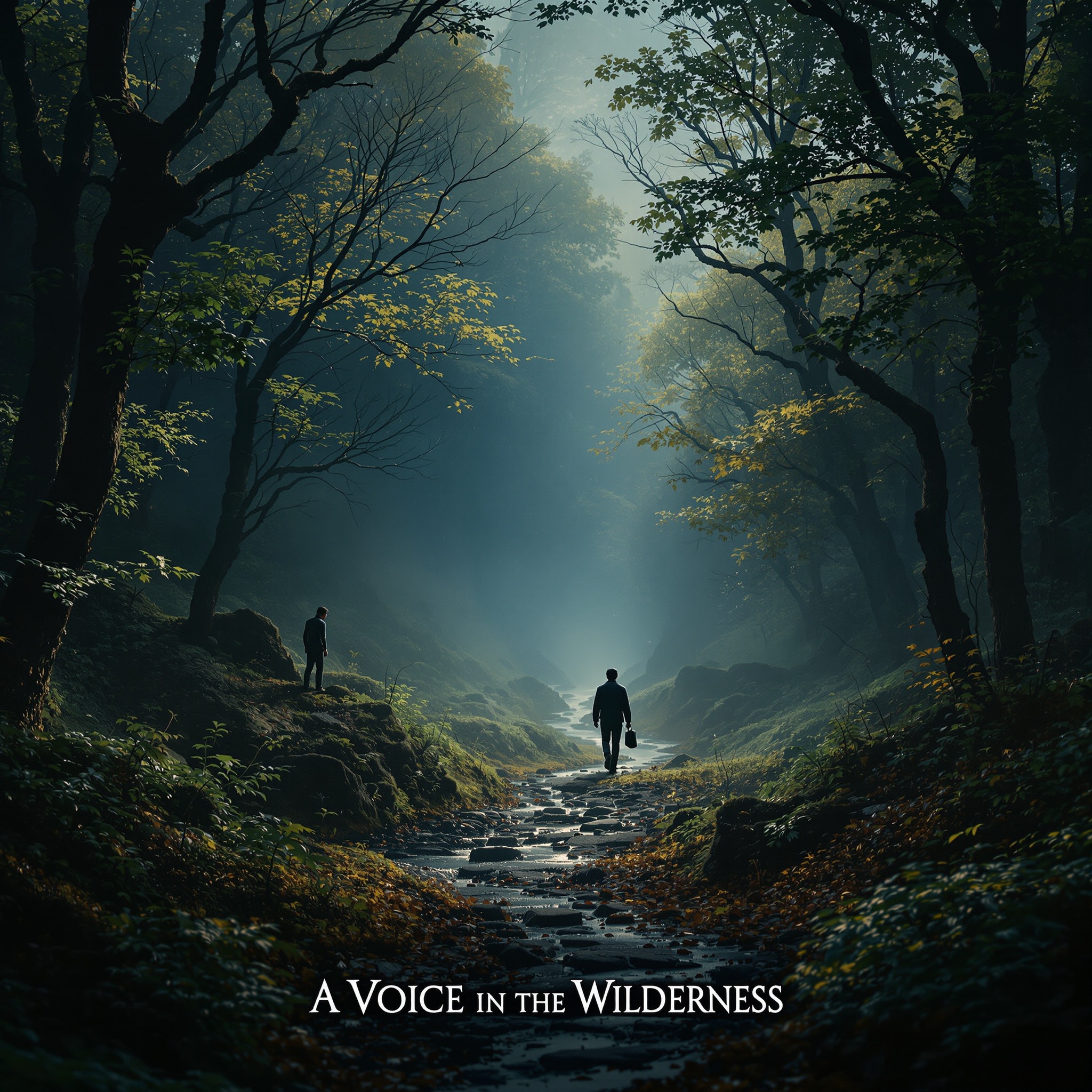
10 · Male vocalRaw desert punk-blues
A Voice in the Wilderness cover art

A Voice in the Wilderness

They came from Jerusalem carrying questions like warrants.
Priests. Levites. A list.
The river asked me nothing.
I didn't move to meet them.
Are you the Christ? I am not.
Are you Elijah? I am not.
Are you the prophet? No.
Then who are you?
They needed something for the report.
I gave them the smallest true thing I carry —
a voice. Crying in the waste.
Straighten the road.
That is the whole assignment.
Not the arrival. Not the throne.
A road crew. An announcement.
A throat clearing before the sentence begins.
Then why do you baptize?
Because one is coming
whose sandal I am not fit
to unlace.
I pour the river over you.
He will pour what the river can't carry.
You want a figure.
I am a function.
You want a throne.
I am a throat.
And even that —
even the voice —
is not mine to keep.
Bridge
Dear committee from Jerusalem —
you brood of vipers — who warned you
to outrun the fire that's coming?
I know the shape of the word you brought in your mouths.
The crowd outside Jericho tried to put it on me.
I walked back into the current.
You want someone to stand at the top of something.
I am standing at the bottom of a river
telling you the floor is about to move.
This is not humility.
This is the only accurate description of what I am.
Coda
He is already among you.
Somewhere in this crowd.
You walked past him
to get to me.

Make this in Suno

Raw desert punk-blues, first-century Judean setting, distorted gut-string bass with no reverb, slap hand percussion like struck camel hide, dry cracked baritone male vocal with zero room ambiance — bone-dry close-mic delivery, no warmth, no gloss. Rhythmic-spoken verse sections transition abruptly into full-throated raw song for aria sections, then drop back to spoken stone-cold pointing in the coda. BPM approximately 88, uneven, breath-driven — the tempo follows the body, not the click. Key of D minor, open and austere. Reed drone low in the mix, single plucked gut string like a distant kinnor in the BRIDGE section only. No chorus swell, no lift, no shimmer. The production is interrogation-room dry: one voice, one room, one question getting smaller answers until silence is the answer.

Paste the style into Suno’s style field and the lyrics above into the lyrics box — the section markers and performance directives are Suno-ready.

11 · Male vocalWitness-hymn, river-wide
The Dove cover art

The Dove

The desert gave me locusts and a purpose.
I preached until the reed beds bent.
They came from Jerusalem, from every ravine in Judea:
I named what they carried into the water,
and the water took it.
I thought I would recognize him by the sky tearing open,
by fire, by the kind of arrival
that swallows its own announcing.
He came to the Jordan as any man comes,
feet on the gravel, robe wet at the hem.
And I knew him —
not by the sky,
but by something older than the sky.
I said: I am the one who needs this from you.
Why do you come to me?
He said: Let it be so.
It is right to fulfill all righteousness.
And I obeyed.
I took him to the center where the current pulls
and I folded him into the river —
in the water where I have done nothing else,
and the water closed over the one
who made the water.
The river ran past us all the same.
And when he rose —
the sky did what I always knew the sky could do.
It opened.
Not with armies. Not with fire.
With a dove —
falling slow enough to land.
And the voice from above — not my breath —
said: This is my beloved Son,
in whom I am well pleased.
I was gripping his arm.
I let go.
He walked up the bank in the same sandals he came in.
He did not turn to me.
The river ran past him.
The river ran past both of us.
All those years in the desert:
the distance, the preaching, the waiting —
I was building toward something.
I was.
I was building an opening —
a single word in a sentence
I would not finish.
They'll ask me later: what did you see?
I'll say: Behold — the Lamb of God,
who takes away the sin of the world.
And they'll follow him —
Andrew, the one beside him —
they'll leave me mid-sentence and walk away.
And I will watch them go.
Yes. Go.
Because the first time I knew him
was before I had eyes to know with:
six months ahead of his birth,
his mother came to a doorway,
and I leapt in the place
where I didn't yet have words.
The body gave the first testimony.
I had no refusal ready.
So the river gives the last one.
He must increase.
I must — — decrease.
The river ran past us all the same.

Make this in Suno

Sacred classical witness-hymn, first-century Galilean acoustic world, desert-austerity palette. Solo male baritone, wild and cracked, desert-roughened timbre, beginning near-spoken on a single sustained pitch and climbing through arioso to full-voiced proclamation before receding to near-speech for the testimony close. Single plucked kinnor-lyre string opens, sustained through the Recitative with no percussion. Reed flute enters as a long falling minor third at the Arioso. Struck metal — thin and bright, angelic — ignites precisely on the Aria's dove moment and resolves on the final syllable of 'well pleased.' No percussion until that single metallic strike. River-wide open strings sustain under the Witness section, gut-stringed, close-mic'd, room-sized reverb suggesting the Jordan's width. Production is dry and intimate in the Recitative

Paste the style into Suno’s style field and the lyrics above into the lyrics box — the section markers and performance directives are Suno-ready.
12 · Male vocalSparse desert psychodrama
Stones and Kingdoms cover art

Stones and Kingdoms

Verse 1
Forty days, and the grit of it is real —
the ache in my gut that a single word would fill.
Forty days teaches the eye to lie:
by the third week, every stone on that floor
had the swell of a loaf about it.
I am telling you the stones looked warm.
He said: if You are the Son of God,
command these stones become bread.
End this fast. One word. Your own word. Who would it harm?
I have shaped things. I have weighed the cost.
I know what a shortcut does to the grain.
I said: It is written —
man shall not live by bread alone,
but by every word from the mouth of God.
A man is not made whole by bread.
Born in the house of bread,
I went hungry on purpose.
Verse 2
He spread them out — the cedar groves of Lebanon,
the Nile's green mouth, the legions ranked in squares
outside Damascus, every ridge from east to west.
He said: one gesture, and the deed is yours by noon.
And I will not pretend the ridges were not beautiful.
They were mine already — that was the lie's fine joinery:
offering a man the thing he came to buy back
at the price of the buying.
I said: It is written —
worship the Lord your God; serve Him only.
I will not serve you.
Some things are not taken.
They are carried up a hill.
Verse 3
Then the Psalms. That was the cleverest —
he put the holy text inside his offer,
angels commissioned to catch my fall
from the pinnacle above Jerusalem,
my Father's care staged as a performance
for a city that loves a spectacle.
He knows the text as a thief knows a tool —
right words. Wrong hands.
I said: It is written again —
you shall not test the Lord your God.
I did not need the city to see.
I needed to walk down the stairs.
Coda
Then they arrived —
and fed what wouldn't bend.
They brought bread.
I did not ask where it was baked.
I ate it slowly,
the way my father taught me
to treat a thing you waited for.

Make this in Suno

Sacred narrative alt-pop, first-century desert setting rendered in bare contemporary production. Single sustained kinnor-lyre string drone throughout, no percussion until the two-bar coda. Male warm tenor-baritone vocal, close-mic'd, half-spoken melodic delivery — intimate and controlled, near-testimony register, no vibrato on refusal lines. Minimal room reverb, almost dry, the voice placed close in the mix as if the listener is the only witness. The three strophes build in lyric density but not in dynamic volume — the intensity is internal, not external. Coda: two bars only, struck metal enters once, clear and bright, then silence. No bass, no drums, no harmonics in the body of the song. BPM approximately 72, in a modal minor. Desert austerity — the warmth of earlier album tracks is deliberately absent here; this is the stripped register of wilderness.

Paste the style into Suno’s style field and the lyrics above into the lyrics box — the section markers and performance directives are Suno-ready.

13 · Male vocalLeaving-the-boats folk-rock, lake air
Nets cover art

Nets

Four of us took the boats out at dusk —
we know these waters, every current and depth.
Rowed to the place where the fish run low,
dragged until midnight, nothing to show.
Andrew pulled the nets up twice, then twice more.
The moon went under. We rowed for the shore.
He was teaching the crowd from the shallows at dawn —
they pressed so close, I floated him out from the shore.
He spoke for an hour. I heard half of it.
Then he turned: "Row to the deep. Let the nets go."
I said, "We fished all night — there's nothing —"
Nevertheless.
At your word.
And then I rowed.
I don't know why I rowed.
Go out again, go out again —
past the place where the water goes dark.
Go out again —
the nets filled up and they started to tear,
the catch dragged down and I went with it —
I told him, "Depart from me — I am a sinful man, O Lord.
Get away from me. I'm not clean."
He said, "Don't be afraid of what you've seen.
From now on, you will catch men."
Then he called me something else — a name.
I don't know yet what it means.
I know it isn't who I was this morning.
I left the nets full on the water.
I left everything. I left everything.

Make this in Suno

Lake-air folk-rock, first-century Galilee acoustic palette, strummed open-D acoustic guitar, hand drum entering at chorus, plucked gut bass string, single ascending kinnor lyre line at renaming lift, no electric instruments, no gloss, room-sized recording with natural reverb suggesting open water and morning air, rough young male tenor vocal close-mic'd, verse delivered in rhythmic speech-song, chorus belted raw with no studio polish, renaming lift half-spoken then returning to full voice, 105 BPM verse loosening to held time at the lift, D major centered modulating to E on the kinnor ascent, atmosphere of physical exhaustion giving way to bewildered awe, sparse production — three instruments maximum until the chorus break, hand percussion doubles at the nets-tearing moment, no strings section, no choir, no orchestral swell

Paste the style into Suno’s style field and the lyrics above into the lyrics box — the section markers and performance directives are Suno-ready.
14 · Male vocalCelebratory folk-soul, wedding-band warmth
The Best for Last cover art

The Best for Last

We ran dry somewhere past the second hour —
I had it tallied, I had it planned.
I count the cups when things go quiet,
watch the servants hovering, understand
the math of a feast before the clapping starts —
that's the job. That's what I do.
The last of what we'd opened: nearly nothing.
And then the rabbi's mother said to who
she said it to — the servants, I think —
whatever he says, you do.
I wasn't near enough to catch the rest.
I was watching the supply go through.
Six jars by the washing court. Enormous.
The kind you fill for ritual, not for wine.
I watched the servants haul the water in.
I watched them fill each jar up to the line.
That's odd, I thought. That's very odd.
And then one of them brought me a cup.
He was grinning at me the way you grin
when you've swallowed something that won't come up.
This is not what we opened at the start.
This is not the vintage I approved.
I can read a vintage by the color in the cup —
I've poured a thousand of them, I've removed
the ones that turned, I've managed every table —
this is —
wait.
This is the kind of thing you don't find at a feast.
This is the kind of thing you don't find.
I set the cup down.
I picked it up again.
I walked across the hall.
Every man serves the good wine first, I told him —
you pour it at the opening, make it count,
and when the guests have had their fill, the rest.
That's how you host. That's the amount
of sense this makes. You spend it at the peak
and coast on through to midnight with the thin.
And I said:
you have kept the good wine until now.
I walked in armed. I had a whole speech ready.
I don't know where the speech went.
I know what came out instead.
Bridge
Six jars. Each one taller than a boy.
Enough to float a wedding, brim to brim —
I know the measure. I'm responsible for the measure.
I've written it. Somewhere. For someone's sake.
Who fills six washing jars with wine?
Who fills them to the brim?
Who brings a cup to the steward last
and grins at him like that, and grins at him?
You have kept the good wine until now.
Coda
The bridegroom smiled at me like I'd crowned him.
The servants watched me with those patient faces.
And somewhere Mary — I believe it was her —
sat down in one of the quieter places.
I went back to the jars. I poured another cup.
Six brimming jars of impossible.
And I'm the one responsible for the tab.

Make this in Suno

Celebratory folk-soul, first-century Galilee wedding feast acoustic palette, male fussy character tenor — mid-weight, professionally clipped with moments of involuntary wonder — full acoustic ensemble with hand percussion driving a buoyant 4/4 at 108 BPM in D major, oud or round-bodied lute carrying the melodic line, reed flute threading playful countermelodies between lyric phrases, gut-string plucked bass providing warm low-end, finger-snapping and light frame-drum clapping on the upbeat, struck metal finger cymbal for the Verdict's landing note, room-sized natural reverb with close-mic'd vocal intimacy, production drops to near-silence on the Verdict line before the full ensemble returns for the Coda, bright and buoyant throughout with a comic-timing lightness in the rhythmic pocket, no gloss, no imperial grandeur — a working feast, a working man

Paste the style into Suno’s style field and the lyrics above into the lyrics box — the section markers and performance directives are Suno-ready.
15 · Male vocalScholarly jazz-noir, questioning
By Night cover art

By Night

Verse 1
I counted the commandments before I could shave.
I have laid forty years of mornings on the text.
I went at night.
There. I have said it.
I went at night because the crowd makes questions
into performances —
and mine were real.
Verse 2
Rabbi, I have heard you.
Rabbi, I have read the signs.
Rabbi, what must a man do
to stand inside the thing you've seen?
Rabbi — how can a man be born
when he is old?
Rabbi, when does a man begin again?
Rabbi —
Verse 3
You said: unless a man is born again —
born from above —
he cannot see the kingdom.
You said: the wind.
You said: it goes where it goes.
You cannot tell where it rises from
or where it lays itself down.
And the wind came through the doorway then —
clean across the low flame —
and the lamp went out,
and neither of us moved to relight it.
Verse 4
I, who have ordered every feast by its season,
who have weighed the Festival by its hour,
sat in the dark I had used for cover
while the dark became the lesson.
I asked you: how can these things be?
You said: you are Israel's teacher,
and you do not know this?
Bridge
The question has lived in me
since the season I put on this robe.
I carried it to you at night
so no one would see me carrying it.
You saw.
You let the lamp stay out.
Verse 5
I walked home before the grey.
The streets were the same streets.
The robe was the same robe.
How — where — when —
I could order every question but the last.
Coda
I am not done with the dark.
I have a feeling
it is not done with me.
Why?

Make this in Suno

Alt-pop folk-classical hybrid, jazz-adjacent sparse noir; measured scholarly baritone male vocal, beginning in controlled speech-song recitative with minimal vibrato, opening gradually to exposed full singing in the aria section, collapsing back to near-speech in spoken passage, ending on a single unresolved falling pitch with no vibrato and long reverb tail; sparse plucked upright bass string as sole rhythmic anchor in verses, brushed percussion entering only at the aria, minor-mode kinnor-lyre in descending figures that grow shorter as the song progresses, struck metal accent on the wind passage, all instruments dropping entirely for the coda; room-sized intimate reverb narrowing across the song — widest at the recitative, tightest at the monosyllabic arioso, nearly dry at the coda; 72 BPM, D minor, melancholy and suspended, no resolution

Paste the style into Suno’s style field and the lyrics above into the lyrics box — the section markers and performance directives are Suno-ready.
16 · Female vocalNoon-heat soul ballad
Everything I Ever Did cover art

Everything I Ever Did

Noon. The others have drawn and gone.
My palms know this rope — how many times,
how many jars hauled up.
A man sat at the curb of the well.
He said: will you give me a drink?
I said: you're a Jew, I'm Samaritan.
We don't mix vessels.
We don't mix anything.
He said: if you knew the gift,
if you knew who was asking,
you'd ask me —
and I'd give you living water.
I said: sir, the well is deep,
and you have nothing to draw with.
Are you greater than Jacob,
who dug this for us, drank from it himself,
and gave it to his children?
He said: everyone who drinks from this
will thirst again —
but what I give becomes a spring
rising up from the inside.
You'll never haul up here again.
I said: give me that water.
So I won't have to keep arriving at noon.
He said: go get your husband.
I said: I have no husband.
He said: that's right.
You've had five —
and the one with you now
isn't yours to keep.
I've had five wells. They all ran dry.
I said: well.
I said: yes.
I said: how.
He saw me.
Not the jar.
Not the noon.
Me.
I said: sir, I can see you're a prophet.
Our ancestors worshipped on this hill —
yours say Jerusalem is the only altar.
Which of us has it wrong?
He said: the hour is arriving —
and it has arrived —
when neither hill contains the only threshold.
The Father seeks those who worship
in spirit and in truth.
I said: I've heard the promise —
Messiah will arrive —
when he does, he'll make all of this plain.
He said: I am he —
the one who is speaking to you now.
And I stood up out of my whole life at once.
The jar sat at the curb of the well.
I didn't reach for it.
I walked.
Then I ran.
Refrain
I abandoned the jar at the well —
I had something better to carry.
Go tell the town, go tell the town —
the one who told me everything I ever did
is sitting at the well. Go tell the town.
The hauling's over.
Go tell the town.
Bridge
Dear town — you know what I've been.
You know the hour I drew, and why I chose it.
You know the five.
But today a man sat at Jacob's well
and he saw what you couldn't —
not what I've done,
what I am.
Find him. See.
Final Refrain
I ran past the road I've always avoided.
I abandoned the jar at the well —
I had something better to carry.
Go tell the town, go tell the town —
the one who told me everything I ever did
is sitting at the well. Go tell the town.
The hauling's over.
Go.

Make this in Suno

Neo-soul / alt-R&B, first-century Galilean inflection, single female alto vocal — worn, warming, conversational-to-belt arc. Production: one sustained cello or bowed kinnor-string drone underneath throughout, hollow wooden hand percussion enters softly at the arioso rung, a thumb piano or struck metal accent marks the husbands rung, bass enters on a single low pulse at the I AM aria — spare, rooted, breathing. Room acoustic: stone well resonance, medium reverb with a long tail suggesting depth. No electric instruments. Vocal sits close-mic'd and slightly dry in the verses, widens in the refrain. BPM approximately 72, rubato in recitative sections, settling to pulse at the refrain. Key of D minor resolving to D major at the final refrain — the tonal shift is the conversion made sonic. Atmosphere: noon heat, stillness before motion, the held moment before a woman runs.

Paste the style into Suno’s style field and the lyrics above into the lyrics box — the section markers and performance directives are Suno-ready.
17 · Male vocalUpside-down-kingdom folk hymn
Blessed Are cover art

Blessed Are

He speaks of poor in spirit — says they own whole sky.
I check my purse. Count what's left. I qualify.
Blessed who mourn, He says. I've mourned each harvest short.
But now I wonder if my mourning is the right sort.
Meek inherit earth — I've been meek since I was born.
I've bent my spine to foremen. Is that what this was for?
Those hungry for right things will find their fill, He says.
I'm hungry. But for bread first. Lord, does that betray?
The merciful get mercy — yes, I've shown that grace,
when I could spare it. When it cost me less than face.
Pure of heart will see God. Heart — or was it breath?
I'm far back in the crowd. The wind takes every fifth
word he says and carries it off across the hill,
and I stand here completing him. Maybe I always will.
Peacemakers, sons of God. I've kept my fists uncurled,
told my children patience — that's how we inherit this world.
He looks across this hill. Sun hits every face.
I walked up for good news.
I found my hiding place.

Make this in Suno

Upside-down-kingdom folk hymn worship, hillside acoustic, strummed open-tuned acoustic guitar in couplet rhythm, hand percussion brushed softly beneath each strophe, reed flute entering only at final two strophes, no electric instruments, no synthesizer, no production gloss. Rough working male baritone, plain-spoken rhythmic speech in early strophes tilting toward full-throated hymn singing by strophe seven, voice sits dry and close-mic'd with crowd-breath as only reverb suggesting the hillside crowd around him. BPM 72-78, key of D major with modal Mixolydian lean, tempo deliberate and unhurried as a man counting on fingers. Dynamic arc: sparse single guitar in strophes one through three, hand percussion enters strophe four, reed flute lifts strophe seven, full texture held through final couplet then stripped to silence. No choir

Paste the style into Suno’s style field and the lyrics above into the lyrics box — the section markers and performance directives are Suno-ready.
18 · Male vocalJoyous stomp, demolition percussion
Through the Roof cover art

Through the Roof

Packed so tight not one of us could breathe —
we shoved, we pushed, we couldn't get him in.
Every doorway a body, every body a wall.
So we climbed. We dragged him up — four of us, one mat —
split the first tile, then the second, then more,
dug our palms into a stranger's ceiling
and called it prayer.
Chorus
We went through the roof for you,
we split the clay till the sky came through,
the crowd looked up, and Jesus looked up too —
we went through the roof,
we went through the roof.
We fed him down through the hole we made,
ropes rough, the drop a long way to the floor.
He landed in a circle of open faces
and Jesus looked up like he knew we were coming.
They say he saw our faith.
Ours. The four of us.
Faith can be a thing you do with ropes.
He said: Son — your sins are forgiven.
Not: rise. Not: walk.
Forgiven.
Chorus
We went through the roof for you,
we split the clay till the sky came through,
the crowd looked up, and Jesus looked up too —
we went through the roof,
we went through the roof.
Then someone in the back said: who gave you the right?
Only God forgives — that's what the law says.
And Jesus said: which is easier to say,
or to prove? Pick up your mat.
And he did.
He walked through the crowd that wouldn't move for him,
through the door we couldn't get him through.
Nobody ever billed us for the roof.
I'd have paid it twice.
The hole is still up there —
our proudest work,
the best thing we ever broke.

Make this in Suno

Alt-pop CCM with first-century Galilean demolition energy, rough young male tenor, rhythmic-speech verses exploding into full-belt chorus, uptempo 126 BPM in 4/4 with heavy stomp-percussion and hand-clap grid. Production opens sparse — single gut-string pluck over a body-percussion pulse — then full band detonates at the chorus: deep frame drum, roof-tile-crack percussive sound design, full gut-string strum, crowd-scale handclaps. Chorus vowels wide and open, voice pushed to chest-belt register. Argument section drops to near-spoken delivery over bare percussion — clipped, fast, no reverb. Walking section collapses to one plucked string and near-silence for 'And he did.' before the full ensemble returns for the final three lines. No studio gloss; close-mic'd breath, room-sized reverb on the chorus, raw edges on the verse. Key of D major, bright and unguarded.

Paste the style into Suno’s style field and the lyrics above into the lyrics box — the section markers and performance directives are Suno-ready.

19 · Male vocalStorm epic with dead-calm production device
Peace, Be Still cover art

Peace, Be Still

I have rowed this lake since the season I was tall enough to grip an oar.
I know the smell before a squall, the particular green before the ridge goes dark.
I know the sound the hull makes when the water decides it isn't finished,
the rope-burn, the bailing, the pitch of a man who thinks he's going under.
I know all of this.
I knew all of this.
The waves were canceling us — we were bailing with both fists,
screaming past each other, we were certain it was finished —
he was asleep on the cushion in the stern
as if he had nowhere to be,
and the cushion was dry.
We woke him like men who had forgotten he was there —
Teacher, don't you care
that we are going to the bottom of this lake?
He stood.
He said to the wind: Peace.
He said to the water: Be still.
And they obeyed him.
No cheer.
No one moved.
The lake went flat — all of it, at once,
flat the whole way to the hills.
And I could hear the wet wood cooling
and the others breathing
and my own pulse working in my jaw —
and nothing else.
Not the way a storm passes.
The way something very large
looks at you
and waits.
Coda
I have fished this lake my whole life.
I do not know what it is anymore.
The storm I could fight.
There is nowhere to put this.
What manner of man speaks
and the wind forgets its own argument —
what manner of man wakes
and the waves decide to be still —
I do not have a word for what I saw.
I have a lake.
I have a question I will carry
until something answers it
or I stop asking.
What manner of man.

Make this in Suno

Alt-pop biblical narrative, male rough tenor vocal, near-spoken delivery escalating to open-throat sustained question phrases, final line spoken not sung. Storm Build: full ensemble chaos — wave-percussion at full intensity, howling reed flute, kinnor-lyre strings in rapid ascending figures, room-sized reverb, no gloss. Chaos Build: same palette, vocal urgency pushing against the ensemble, rhythm collapsing. The Rebuke: DEAD SILENCE — full ensemble cuts mid-statement at mix level, no reverb tail, vocal alone in a dry room, three lines with zero production underneath. Dead Calm: sub-bass drone enters barely audible, single struck-metal note decaying, no percussion, wet wood texture in room sound. Coda: sparse plucked gut strings, open fifths, vocal sustaining on long vowels, sub bass, 80 BPM, no resolution chord, ends on the question unanswered. Key of D minor, no major resolution.

Paste the style into Suno’s style field and the lyrics above into the lyrics box — the section markers and performance directives are Suno-ready.
20 · Male vocalA father's song, breaking and mending
Talitha Koumi cover art

Talitha Koumi

Verse 1
I split through every body in that street.
I did not care whose elbow, whose complaint.
I fell — not slowly — fell the way a man
falls when he has run out of being proud.
In the dust my cloak caught the hem of his robe
before my mouth found the sentence:
Teacher — my daughter —
she is twelve years old —
that is all she has.
Verse 2
He rose, he turned, he followed — I was leading.
And then the crowd closed in and he stopped cold.
He said: who touched me?
The disciples said: Rabbi, everyone is touching you.
And I stood there.
I stood there while she —
I stood there.
Verse 3
He came with his mouth closed
and his eyes already said it:
your daughter is gone.
Do not trouble the Teacher further.
And he turned — not to the crowd, to me —
be not afraid.
Only believe.
Two instructions.
I could manage neither.
I walked.
Verse 4
He let no one follow except those three.
The house was full of weeping and he said:
why this noise? She is sleeping.
And they laughed at him —
in my house, at my grief, they laughed.
He put them out.
He took her hand.
Talitha koumi —
little girl, get up.
And she walked.
Twelve years old and she walked across the floor.
Bridge
There was a woman in the crowd —
no rank, no announcement, just bleeding,
twelve years —
and the Teacher stopped for her
while I stood there
and my daughter —
One number, worn two ways.
Her twelve ended the year my daughter's started.
He had time for both.
I am still learning that he had time for both.
Verse 5
He said: feed her.
And I heard her eating.
I heard her teeth on the bread,
and the weeping I had swallowed in the street
came up all at once,
and I let it.
Coda
He said: why this noise?
I know why the noise.
I could not — I could not —
I could not remember
why I ever wanted this house quiet.
Let it be loud.
Let this house be loud
for the rest of my life.

Make this in Suno

First-century acoustic song-novel, alt-folk sacred, E minor resolving to G major. Male baritone lead — warm chest voice, synagogue-ruler authority that fractures under pressure; near-spoken delivery in plea and interruption sections, full vocal presence only at 'Be not afraid,' near-silence on the Aramaic two words. Instrumentation: single bare kinnor-lyre pluck for plea and worst-sentence sections; reed flute enters at answer; full ensemble of hand percussion, gut strings, struck bronze for the room and two-words sections; everything strips to near-silence for 'Talitha' — two syllables with only room reverb; G major resolution on the eating, warm and unresolved. 85-95 BPM, intimate room acoustic, no reverb gloss, close-mic breath. Dynamic arc: desperate and compressed → suspended → collapsed → stripped to silence → quiet resolution that does not comfort.

Paste the style into Suno’s style field and the lyrics above into the lyrics box — the section markers and performance directives are Suno-ready.