Skip to content
← Showcase albums

Book of Voices - Volume 1

What happens when gift becomes possession?

Earthen and elemental throughout — wood, skin drums, breath, gut strings, open air. Pre-industrial palette; nothing electric unless disguised as weather. Tracks I.1–I.2 are locked as the volume's reference tracks: the sonic family is defined there. The palette evolves from cosmic-choral vastness (I.1) through intimate fingerpick (I.2), grinding blues earth (I.5), claustrophobic hull-creak (I.7), fracturing polyrhythm (I.8), desert oud-dust (I.9), torch-jazz brush-and-gut-bass (I.11), haunting art-pop suspension (I.12), sparse three-day-walk dread (I.13), gospel brass warmth (I.19), to unaccompanied deathbed voice (I.20). Motif cells (THE LAMB, WATER, THE NEW NAME, REMEMBER ME, WOOD/THE KNOCK, BREAD) are introduced at their appointed tracks and frozen at volume close. Production rule: too loud if a first-listener can name the cell; too quiet if a re-listener cannot find it.

20 tracksone concept · one palette
Read it as a song-novel →
Book of Voices - Volume 1 Radio00 / 20

Loading…

0:00
0:00

Space play/pause · ← → seek 5s · J/L seek 10s · M mute · N/P next/prev
01 · Female vocalCosmic choral art-rock / earthen family
Before the Light Had a Name cover art

Before the Light Had a Name

Nothing.
Not even the word for nothing.
I was folded into the unmade
the way heat lives in stone before the sun.
Then —
the first sound:
not quiet breaking.
Quiet discovering it was not alone.
Water from water.
He divided, and I felt the dividing
the way you feel a word
the moment before you say it —
that tautness. That almost.
He said: sky.
And sky opened — all of it, at once, no hesitation.
He said: dry.
And the earth wrenched itself clear of the sea.
Then the growing things —
oh, the growing things —
rooted before anything knew what roots were for,
reaching toward a sun
that did not yet know it would be named the sun.
The creatures —
running before run was a word,
wheeling before the sky knew it had a ceiling.
I rang with it.
Do you understand?
Before grief was possible,
I rang with it.
And then —
the clay.
He shaped the earth into a form
and I leaned in
toward the warmth of it —
a fire that was not burning me.
And He gave —
not lent.
not left for safekeeping.
not placed where it could be admired and not touched.
Gave.
The whole gift, unreserved,
poured into the man made out of clay
like water into a vessel
that could not know if it would hold.
I was beside Him.
I was beside Him when He did this.
Rejoicing.
Wide with it.
Bright.
Coda
And I knew —
even then, rejoicing,
even with the delight warm in me —
the knowing came untold,
unasked,
and I wished I were not the one who knew it.
Someone would press the given thing between his palms
and call that love.
The gift would be counted, and compared, and claimed.
But that morning —
that first morning —
it was given.
It was given, and the earth held fast,
and the creatures that would be named
leaned into the naming,
and I was beside Him,
and I was glad.

Make this in Suno

A weathered male voice, low-mid range with soft rasp and cracked edges, He sings close to the mic like he’s afraid to wake the house, Every breath is audible; consonants brush against silence, The guitar is dry, unpolished, a single mic capturing room hum and chair creaks, His phrasing drifts slightly behind the beat, like he’s remembering the words as he goes, No harmonies, Let the spaces between lines ache — grief disguised as composure, Minimal compression; dynamics breathe and break naturally

Paste the style into Suno’s style field and the lyrics above into the lyrics box — the section markers and performance directives are Suno-ready.
02 · Male vocalTender fingerpicked acoustic / folk
Bone of My Bone cover art

Bone of My Bone

Verse 1
I filled the vessel at the river, mist wound in grass
The ox stood close — where it always stood
I spoke the cedar's name and heard it fall unlifted
Seven seasons, staff worn smooth — the naming never took
Verse 2
The hawk came low across the reed beds where the river bends
I gave it every syllable a hawk could carry
The dove called out at morning, made a question of the air
I spoke for grass, for gravel — spoke the dark where waters feed
Verse 3
They always came in twos — I thought that was simply how they moved
The doe beside the stag, the swift beside the swallow
I did not know — I swear I did not know —
what I was counting until I was done
Something stood empty in me, vessel-deep,
a want I couldn't name and couldn't follow
I named until the dark had nothing left to answer
Verse 4
I fell asleep mid-word, mouth shaped around a sound
My fists unclenched in sleep — they'd been closed since dawn
I woke — my side was warm, no wound, no mark, no seam
I pressed the space where something had been — pressed and pulled away
Verse 5
She sleeps beside me, palms curved around a thing I cannot name
I cannot look directly — I look at my own shadow
She grasps her own wrist — I thought that was only mine
Her breath is the first sound that has not risen from my ribs
Bridge
The hawk took what I gave it and was gone
I gave each thing a word — the word bore nothing
I open my mouth now —
I close it
Verse 6
You will open your eyes and I will have no name prepared
The vessel by the river, cold and full — I'll leave it there
I'll reach across —
I don't know if it's offered or it's taken
Bone of my bone — and my arm is shaking

Make this in Suno

Pastoral fingerstyle folk. Warm male tenor, intimate and conversational, opening into an unforced full voice on “Bone of my bone.” 66 BPM, G major, gently rubato. One close nylon-string guitar carries the entire song; natural string squeaks and outdoor dawn air are part of the recording. Long narrative lines should feel sung to one sleeping person. The final turn falls back toward near-speech tenderness.

Paste the style into Suno’s style field and the lyrics above into the lyrics box — the section markers and performance directives are Suno-ready.
03 · Female vocalDark folk noir
The Fruit Was Beautiful cover art

The Fruit Was Beautiful

Verse 1
I tasted it. It tasted real.
The skin broke open, and I swallowed the words.
And the garden held its shape —
only I had moved.
Verse 2
He asked me what God said.
He asked it like a friend
checking I'd heard right.
Did He really say —
and the question left a gap
the size of my own voice,
and I filled it.
Verse 3
You will not surely die.
It wasn't a lie the way lies sound.
It was a door
where I had always seen a wall.
Refrain
Knowing is seeing.
And seeing is wanting.
Wanting is having, I told myself —
the sentence he started in me,
and I finished it. I finished it
as ripe undoes green.
Verse 4
The branch bent low. It always had.
The tree was not new. The reach was new.
I closed my palm. I kept it.
Keeping is keeping.
And keeping felt like receiving.
Verse 5
The bark remains the same bark.
The fruit is gone. The body keeps the going.
I open my hand — it won't go.
The gift is where my hunger was.
Bridge
I turned, and he was with me.
He had been with me the whole time.
I held it out.
He looked at me, not at the fruit.
Outro
And took.
Tasting it, I became it.

Make this in Suno

Dark open-tuned folk noir. Female mezzo-soprano, close and controlled, with a restrained melodic lift only on the central refrain. 60 BPM, E Phrygian. Sparse acoustic fingerpicking and one low bowed-string pedal tone create unease beneath the voice. The arrangement remains intimate and almost motionless until “Knowing is seeing,” then tightens briefly before collapsing back into a bare final confession.

Paste the style into Suno’s style field and the lyrics above into the lyrics box — the section markers and performance directives are Suno-ready.
04 · Male vocalAmericana lament
East of Eden cover art

East of Eden

Verse 1
The flaming sword didn't make a sound when it closed.
That's what I remember. The quiet swallowed it whole.
I thought fire would roar.
Verse 2
I had the rind with me —
the piece I peeled back and held while she bit
and I stood there
receiving,
and then I bit too —
and the seeds were inside,
three of them, slick and dark,
and I cupped them
because they were the last thing I touched in there,
and I was already walking east.
Verse 3
I took them out.
I didn't mean to, or I did.
The ground here takes back —
takes its tithe from every step I give it.
And the sun —
the sun is asking now.
In the garden it only gave.
Refrain
What do I plant that isn't grief.
What grows where the sword burns on.
Bridge
I was given the garden and everything in it,
and I was asked to name —
every creature, every green and crawling thing,
and every name I gave was given back.
I named them right.
Every one.
Before I ever stood at the tree
and reached.
Verse 4
I don't know what I'm called on this side.
Final Verse
But I close my fist now
around three seeds I didn't plant
and I walk east
where the ground costs
and the sun asks
and I am answering —
not because I know what for.
Because the ground is waiting
and the seeds are real
and I am already moving.

Make this in Suno

Dust-blown exile waltz, 6/8 at 66 BPM. Male baritone with a weathered, walking delivery. Slow strummed acoustic guitar, brushed floor drum, low bowed bass, and huge empty space between phrases. The refrain should widen emotionally without becoming a conventional chorus. The bridge loses all rhythm; the final verse resumes as a man walking because he has no other choice.

Paste the style into Suno’s style field and the lyrics above into the lyrics box — the section markers and performance directives are Suno-ready.
05 · Male vocalHeavy blues
My Brother's Keeper cover art

My Brother's Keeper

He stepped back.
Not away.
Just back.
The dust was red.
The dust closed.
I walked east.
Every road I walk now
the men step back
before they see my face.
That is the price.
That is also the proof.
Refrain
I am alive.
God said protect me.
So.
I brought Him what I grew.
I pulled it out of ground
that was cursed before I got it.
He walked behind sheep.
His went up clean.
Mine did not.
I have had years to say why.
I still can't say it
without my hands closing.
Refrain
I am alive.
God said protect me.
So.
Whoever kills me
carries sevenfold shame.
So no one will.
So no one —
And the ground speaks.
I hear it when I dig.
The ground he is in
speaks.
So I stopped digging.
I am building instead —
a city, east of everything.
Walls keep things out.
That is what I tell the walls.
Bridge
He was not wrong.
He was not —
I cannot —
The offering was — his was —
He was right.
I have always known it.
The mark keeps me alive.
Nothing keeps me company.
Final Refrain
I am alive.
God said protect me.
So.

Make this in Suno

Devotional Delta-blues dirge, 12/8 at 70 BPM. Deep male baritone, almost speaking in the verses and breaking into chest voice only when the guilt becomes unavoidable. Dry bottleneck resonator guitar, hand-struck skin drum, low acoustic bass drone. Hide the falling minor-third LAMB cell beneath the resonator during the second refrain. Heavy, physical, and unresolved.

Paste the style into Suno’s style field and the lyrics above into the lyrics box — the section markers and performance directives are Suno-ready.
06 · Male vocalWork-song stomp
Build It Anyway cover art

Build It Anyway

Intro
Dry wood-knock percussion alone — three strikes, then the groove
Verse 1 - call, speech-paced
Neighbor voices, taunting, rhythmically free
So you're out here now.
Knock. Knock. Knock.
No clouds since the barley harvest.
Not a whisper of a cloud.
Knock. Knock. Knock.
My father built on solid rock.
He left me something.
What will you leave yours?
Post-Chorus - crowd
A ship.
A ship!
A ship on dry rock!
He's building a ship!
Chorus
Locked 4/4 work-song pulse, full chest voice
Each beam I've swung through, each peg I've buried
Ground that has no memory of wet
I started on a day like this — no sign, no cloud, no reason
I'm not done yet
Verse 2 - call and response
When you stand there in your certainty
I've stood in mine since longer than you've counted
You see the sky and call it proof —
The sky was clear the morning that I started
Spoken
We're not against you, friend.
We just don't see the rain.
I know.
So why?
Chorus
Each beam I've swung through, each peg I've buried
Ground that has no memory of wet
I started on a day like this — no sign, no cloud, no reason
I'm not done yet
Verse 3
Ask me something I can answer
Ask me what the wood weighs, ask me where the seams sit
Don't ask me when — that's not my count to keep
When the water says so
Not before
Bridge - stripped back
Percussion drops — voice and one sustained gut-string note
The pitch smells like pine resin and old blood.
In the workshop, I don't ask myself why anymore.
Somewhere up on the ridge a child is watching —
she'll remember it whole, the hull taking form against the rock.
That's enough.
Spoken
When does it float?
Final Chorus
Full stomp returns, hardest hit of the track
Each beam I've swung through, each peg I've buried
Ground that has no memory of wet
I started on a day like this — no sign, no cloud, no reason
I'm not done yet
Outro
Percussion thinning to the bare knock
When the water says so
Not before
When the water says so
Not before

Make this in Suno

Dry wooden work-song, 96 BPM, D Mixolydian. Deep male baritone with mocking crowd responses, rhythmic calls, and forceful communal answers. Three wood strikes establish the groove; frame drums, foot stomps, acoustic rhythm guitar, and low bass push the chorus forward. The bridge drops to one voice and one sustained string. Final refrain should feel earned, muscular, and defiant rather than triumphant.

Paste the style into Suno’s style field and the lyrics above into the lyrics box — the section markers and performance directives are Suno-ready.
07 · Female vocalClaustrophobic chamber folk
Forty Days cover art

Forty Days

He said: go in.
I went.
The ramp rose
and the world
we knew —
I don't finish that.
The ox beside me
pushing air
through the dark
like he trusts something I don't.
I put my palm to the hull
and the water on the other side
pushed
like a thing
that had not been told.
Everything I loved
that didn't fit the door
is out there
in that moving.
The cedar smells like sap
and rot
and forty days of dark.
He built this.
I sleep against it.
The gift arrived in his name —
the measure, the span,
the length of it.
And I am the margin
the plan required.
What he received as calling
I received as walls.
But the ox breathes.
The dove is somewhere above,
wing-folded.
Something in the wood knows
the water will tire.
I press my palm harder.
Feel it —
cold, patient,
older than the word for it —
and underneath the cold:
a current
like a question
turning.
Bridge
And I wonder, pressing my palm into the cedar
that smells like sap and animal and forty days of dark,
whether the water out there knows my name
the way it knew the names of the fields
and the houses
and the faces I will not say out loud in here
because if I say them they are gone
and they are already gone
and I am the one who kept going in.
He said: go in.
I went.
That is the whole of my covenant.

Make this in Suno

Claustrophobic flood chamber-folk in free time. Female alto, nearly motionless in the verses, rising only when the emotional pressure becomes unbearable. Bowed cello slightly below pitch center, trembling viola, rare low frame-drum pulse, and an unresolved ascending WATER figure. The listener should feel inside the ark: breath, cedar, animals, walls, weight. End smaller than it began.

Paste the style into Suno’s style field and the lyrics above into the lyrics box — the section markers and performance directives are Suno-ready.
08 · Male vocalPolyrhythmic world-fusion / fracture piece
One Language cover art

One Language

Verse 1
We chose this plain because the clay takes shape
and because we were afraid of being scattered.
We pressed ourselves into one people.
One tongue: we put it to the work.
Chant — locked work-pulse
Lay it. Fire it. Bite it higher.
One tongue, one name, one tower to the sky.
We write our name where no flood reaches —
we pull the word right out of the air.
Verse 2
I know the word for stone.
I know the word for fire baked into brick.
I know the word for the name we are building toward,
and we said: it will not flood again.
Not again. Not again.
The plain is ours. The clay is ours.
We are the thing that names the sky.
Chant
Lay it. Fire it. Bite it higher.
One tongue, one name, one tower to the sky.
The Break — pulse stumbles
I turn to call to the man beside me —
we built the same wall for a year,
I know his laugh,
I know the word he used for bread.
Used.
His mouth is moving
and nothing arrives.
Leh — leh —
Bav —
What is — what is the word —
He stares.
I stare.
In the scaffold's shadow, the brick waits in my hands,
holding the word I cannot give him.
We said: one tongue.
We meant: one fist.
We thought language was the ladder.
Chant — degrading, pulse collapsing
Lay it — fire it — bite it —
lay — leh — la —
one tongue — one — wuh —
the name — the name is —
Outro — voice alone
But I —
I am still naming.
I am reaching for the word,
even here.
Even in the rubble.
I have the brick.
I have no word for it.
...what did I call this?

Make this in Suno

Acoustic ritual art-rock. Commanding male baritone over interlocking frame drums, clay-pot percussion, handclaps, oud, and low plucked bass. Begin tightly locked at 108 BPM with collective confidence. Midway through, the groove loses coordination: rhythms misalign, phrases shorten, instruments stop answering one another. Final section is nearly unaccompanied voice and a single slowing drum pulse. No standard chorus structure.

Paste the style into Suno’s style field and the lyrics above into the lyrics box — the section markers and performance directives are Suno-ready.
09 · Male vocalDesert wandering-folk / oud-tinged
Leave Your Country cover art

Leave Your Country

Intro
Solo oud, sparse, long sustain — predawn stillness
Verse 1 - half-spoken, dry
The fire had been cold since before the first star disappeared.
I packed what I owned — tent cloth, flint, seed for scattering,
the woman who came when I asked her to come.
I did not pack what I left. That was how I knew I was going.
Verse 2
Frame drum enters at walking pace
Ur behind me now, the mud-brick towers
shaped by men who stayed.
I pulled the pegs myself in the dark before dawn,
each one leaving a sound like a question answered too late.
Verse 3
The Voice had not said: at the river, turn.
Had not said: three days, then water.
Had only said: go from your country, your people, your father's house —
and I went, because the burden had found me
in a city that had never once looked up.
Chorus
Voice opens into the reverb — full chest, awe
And the sky —
oh, the sky this far from city smoke,
wider than anything men have yet learned to name —
I raised my face and felt it receive me
like something that had been waiting
for one man to arrive without a map.
Verse 4
The Voice made me a country out of a promise.
I tried to hold its shape. I lost it
at the place where the horizon swallowed the last of Ur's fires behind me.
I kept walking. The promise kept ahead of me.
This was not comfort. This was instruction.
Verse 5 - intimate, half-spoken
Sarai slept on the cart. I had not told her: I don't know where.
I said: the Voice said go. She looked at me — patient
with whatever shape she's poured into.
I owe her a destination. I carry only a direction.
Verse 6
The sand already changing beneath my feet — less river-mud,
more the color of old argument, old heat.
Somewhere ahead: a land I will show you.
Show — not tell. My mouth around the word
like a man who has been promised a feast
and handed an empty bowl to carry.
Bridge - stripped back
Drum drops — oud and voice only
I am not afraid. Or: I am afraid the way a man is afraid
who has already left and cannot go back —
which is not fear exactly.
It is walking.
Final Verse
Drum returns, voice cresting
I thought the promise was a place.
I am learning the promise is a practice —
this: one foot, then the other, into ground that has no name for me yet.
The road is not a distance.
It is a direction.
Outro
Arrangement thinning to solo oud under the last lines
I drove the first tent peg into foreign soil just before the sun arrived.
The sound it made going in
was not the sound it made coming out of Ur.
Something received me.
I do not know what to call it yet.
I stand beneath a sky that is not Ur's sky
and feel, for one moment I did not choose,
the smallness of a man who has been chosen.

Make this in Suno

Desert road song, 74 BPM, modal D with Hijaz color. Warm male baritone, half-spoken in the packing scenes and opening into wide melodic phrases under the night sky. Solo oud leads; walking frame drum, hand percussion, and low drone create forward motion without urgency. The bridge strips to voice and oud alone. The closing should feel like a tent peg entering unfamiliar ground.

Paste the style into Suno’s style field and the lyrics above into the lyrics box — the section markers and performance directives are Suno-ready.

10 · Male vocalNight-sky ballad / folk
Count the Stars cover art

Count the Stars

Verse 1 - near-spoken
He walked me out
past the tent wall
past the fire's reach
into the cold that has no name
Spoken
He said: Look up.
Try to count them.
Verse 2 - whispered
I looked up.
One.
Two.
I lost the thread.
Verse 3
The sky is not a ledger.
My finger has no business here —
tracing light
that set out before any grief existed.
Refrain
First sustained melodic phrases — quiet, vast
And yet I count.
And yet I count.
Because the Breath said: So shall
your offspring be.
So shall.
So shall.
A number I will never reach
is a number nonetheless.
Verse 4
Then He said a new thing.
He took the name I'd worn
since Ur,
since my father's house,
since my name was wet clay —
He breathed a syllable into it
I had not owned before.
Chorus
THE MODULATION: key lifts a whole step exactly here — the one harmonic event of the track
Abram
is not the name anymore.
Abraham.
Verse 5
New key held, still sparse
The sky did not change.
My knees throb with weight.
The stars did not rearrange themselves
into sons.
But I am standing in a name
that is bigger than I am —
a room I have not grown into,
a promise wearing
the form of a man.
Bridge - stripped back
Lute drops to single repeated note
When the boy becomes arithmetic —
when none of this is a story
and only an old man
shivering in the dark —
I will have believed it.
He wants the yes
before the proof.
Outro
Voice nearly alone, frame drum breath under the last lines
I will count again tomorrow night.
I will not reach the end.
That is the point.
That is the point.

Make this in Suno

Night-sky sacred folk nocturne. Aged male baritone, low and unhurried, over sparse plucked lyre and occasional distant frame-drum breath. 52 BPM, wide desert air, long silences. The entire arrangement stays restrained until the name change: on “Abraham,” lift the harmony exactly one whole step, quietly and unmistakably. Hold the new tonal world without adding grandeur. End with a man still counting.

Paste the style into Suno’s style field and the lyrics above into the lyrics box — the section markers and performance directives are Suno-ready.
11 · Female vocalDesert-outcast soul-folk
The God Who Sees Me cover art

The God Who Sees Me

Verse 1 — half-spoken, flat
She counted the years first.
Then she counted me.
Verse 2
Her idea — all of it.
I was the answer
to a question
she could not bear
to keep asking.
And when the answer
began to breathe
and move
and take up room
inside the tent,
she made the tent too narrow
for both of us.
No raised voice.
Just the tent-flap
and the road.
Verse 3
I walked south.
Not because south was an answer,
because south was away,
and away
was the only direction
I had the right to choose.
The sand recorded my feet.
I kept going.
Verse 4 — quiet arpeggio enters, unresolved
The spring found me
the way thirst finds things —
not looking, exactly,
just arriving.
I sat down by the water.
I was not praying.
I had no language left for prayer:
only the dust on my arms,
only the child already moving in me
like a question
I did not ask
and cannot put down.
Verse 5 — hushed
They had a word for what I was.
Shifhah.
Handmaid.
The word that lets a person
stand inside your tent
and still remain
outside your grief.
Abram’s breath was gentle
when he said it.
That was the worst part.
So gentle.
He had practiced
not seeing.
Pre-Chorus — one held note
And then —
Something located my name.
Not Abram’s name.
Not Sarai’s God, not yet —
mine.
Spoken
Hagar.
Where have you come from?
Where are you going?
Verse 6
I said: I am running
from the hand of my mistress.
I said it plainly.
No shame in it by then.
The shame had walked off
somewhere around the third day.
Verse 7 — arpeggio returns, intimate
And then the spring —
water pressing through stone,
unhurried,
like it had always been there,
which it had,
quieter than my breathing,
and not stopping.
Spoken
I thought: this is what a gift feels like
when it passes through you
and no one calls it yours.
Then I thought:
but the water is here.
The knowing is here.
And the knowing said my name.
Chorus — first full melody
So I named Him back.
El Roi.
The God who sees.
Not because I was brave,
because I was the only one
who had nothing left
to pretend with.
Verse 8
Sarai has a tent.
Abram has a promise.
I have this spring
and a name I gave
to the one
who gave me mine back first.
Whispered
Have I really seen Him
and lived?
Outro — unresolved
The question stayed in my mouth
all the way back.
There now.
The spring behind me,
the water pressing through stone,
continuous,
unfinished —
I went back.
Not because I forgave them.
Not yet.
Because the knowing said: go back.
And the knowing had said my name
before it said anything else —
which meant their word for me
was not the last word.

Make this in Suno

Desert-spring spiritual, slow 6/8 at 84 BPM. Female alto with plainspoken verses that slowly become melody as she reaches “El Roi.” Nylon-string guitar, low bowed bass, quiet hand-drum breaths, and the unresolved WATER figure on a single plucked string. The production begins dry and close, then opens slightly at the naming moment. This is not victimhood; it is the sound of a person being located.

Paste the style into Suno’s style field and the lyrics above into the lyrics box — the section markers and performance directives are Suno-ready.
12 · Female vocalWry torch-jazz turning to joy / earthen palette
She Laughed cover art

She Laughed

Verse 1 - spoken over bass and brushed snare
Three men by the oak trees, and one of them was different.
Abraham ran out to meet them — that's Abraham, running,
which he hasn't done since the camels got loose in Egypt.
I stayed in the tent.
I punished bread.
I listened through the hide.
Verse 2
Piano enters, sparse
And it said: where is Sarah your wife?
And Abraham said: she is there, in the tent.
And it said: I will return in the spring,
and Sarah will have a son.
Pre-Chorus
Beat hesitates — brushes only
And I —
I laughed.
Verse 3
I didn't mean to.
It came out before I could grab it —
my hand went over my mouth before my brain did.
The sound a tent makes when it can't keep a secret.
Thirty years of visitors who ate our bread
and left us with nothing but a longer wait.
I laughed.
It came from somewhere low and real.
Verse 4
And then it said — and I want you to notice
it said this not to me, not to my face,
but to Abraham, like I was in the tent:
"Why did Sarah laugh?"
And I thought: I didn't.
I definitely didn't.
My face said: I didn't.
The kitchen said: I didn't.
My whole body said:
I have been waiting thirty years to laugh
and I did not just laugh.
Spoken
But I did.
Chorus
First sustained singing of the track — restrained swell
And it said:
is anything too hard?
Is anything —
And that was the whole argument.
Four words.
I stood there holding flour.
I said: I didn't laugh.
It said: you did.
And I understood:
He wasn't scolding me.
He was keeping count.
Bridge - stripped back
Gut-string bass alone, no percussion
Before any of this —
before the tent, before Canaan,
before the promise even had a name —
I was a girl in Ur who wanted a daughter
and I thought that was a simple enough thing to ask.
I stopped asking somewhere around the third decade.
I got very good at not asking.
I was excellent at it.
Final Verse
Full palette returns, warm — the turn
Nine months later I named the baby.
Not Promise. Not Miracle.
I named him the laugh.
That specific sound.
Because the joke —
the joke is the evidence.
The thing I couldn't keep in
is the thing that keeps him.
His name is the laugh I swallowed.
And every time Abraham calls him across the tent-yard,
every time I hear that name in the morning —
I think:
God kept the laugh.
God kept it.
Put it right in the baby's name
so I'd have to say it every morning
for the rest of my life.
Outro
Everything falls away — voice, then one piano note
Isaac.
Laughter.
Mine.

Make this in Suno

Wry torch-jazz chamber song, 88 BPM. Female alto with dry wit, conversational timing, and a sudden warm melodic release on “Isaac.” Brushed snare, upright bass, close acoustic piano, occasional handclaps, and small-room intimacy. Let Sarah talk over the band in places. The bridge strips to bass alone. The final verse becomes genuinely joyful without losing the humor or intelligence of the opening.

Paste the style into Suno’s style field and the lyrics above into the lyrics box — the section markers and performance directives are Suno-ready.
13 · Male vocalSparse dread-folk
The Wood on His Back cover art

The Wood on His Back

Intro
The dry wood double-strike alone — two hits, silence, two hits
Verse 1 - whispered
Third day.
The servants wait below.
Verse 2
I split the wood before we left —
it rode beside us three days, knocking.
At the foot of the climb
I lifted it onto his back myself.
My own hands.
He took the weight without asking.
He walked ahead a while.
I watched the bundle shift.
Verse 3 - half-spoken
Dry cedar.
I cut it.
I carry the fire.
I carry the knife.
I gave him the wood.
Let no one tell this gently.
Spoken
Cello drops out — voice and silence
Father —
where is the lamb?
Verse 4
I said: God will provide.
And I went ahead of him.
I could not watch his face.
Verse 5
The path narrows here.
Two stones mark the place
where I will build.
Refrain
The double-strike lands on each "dry wood"
The bundle on his back
makes a sound when he steps —
dry wood.
Dry wood.
Dry wood.
I count his steps.
I do not stop.
Verse 6
I said: we will return.
Both of us.
I don't know
if I lied.
He must not learn
what the wood is for.
Not yet.
Not from me.
Verse 7 - minimal
I build the altar with my own hands —
the same hands that gave him the wood.
This stone. Then this stone.
He watches me.
He does not ask again.
Bridge
Everything stops except the cello — one sustained note
My hand moves
before I know it.
Then —
Outro
Dead silence, two full beats — then voice alone, bare
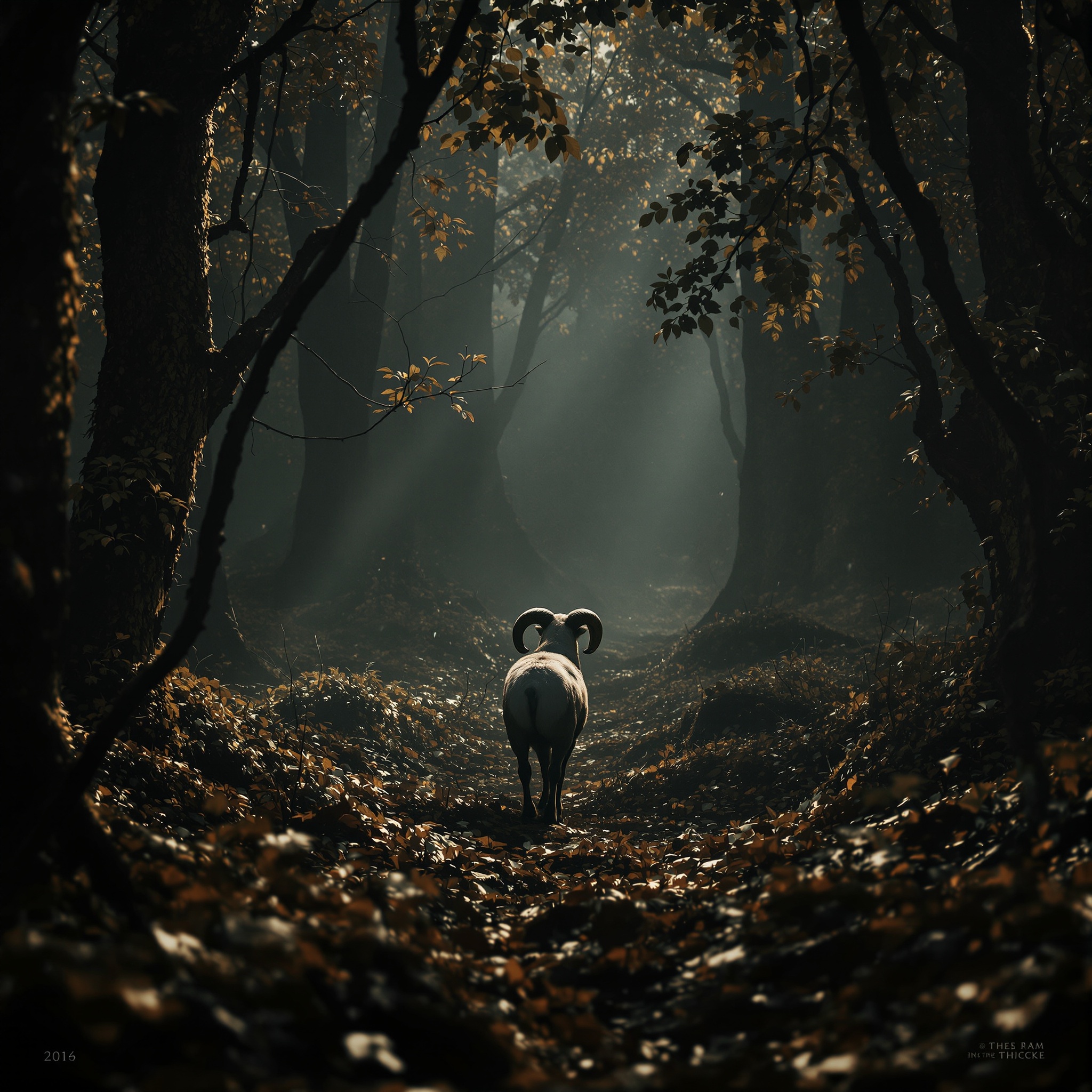
The ram.
Already there.
Already caught in the thicket —
horns in the branches,
still.
I did not see it
until now.
I did not need to
until now.
We call this place:
The Lord Will Provide.
He was providing
all the way up the mountain.
I said it before I knew it.
I mean it now.

Make this in Suno

Three-day dread folk, 60 BPM, D minor. Deep male baritone, almost whispering over a dry wooden double-strike that lands like footsteps. Low cello sustains appear only at moments of unbearable pressure. Sparse gut-string plucks mark the ground beneath him. The LAMB interval appears once, distant, at “God will provide.” Long silences are structural. The ram arrives after two full beats of emptiness.

Paste the style into Suno’s style field and the lyrics above into the lyrics box — the section markers and performance directives are Suno-ready.
14 · Male vocalTrembling aftermath hymn
The Ram in the Thicket cover art

The Ram in the Thicket

Verse 1 — near-spoken
The smoke rises behind us on the hill.
I do not look.
I am the one who carried the wood.
My father walks beside me and does not speak,
and I do not ask him to.
Verse 2
I brought the wood up on my back.
He carried the fire and the knife
and a yes he had already given
to something I could not see.
Verse 3
He stacked the stones in the clearing
with a certainty that knew
what his mouth had not said yet.
I watched him do it.
Verse 4
He bound me like a man who had wept already.
Not in anger —
in something older than anger —
letting go
before the letting go broke him.
Pre-Chorus — strings hold
The knife was up.
The sky was open wide.
I did not close my eyes.
Spoken — voice alone
Then the Command came.
Then the ram.
Then my father at the rope, tearing —
Verse 5
I want to say: I was not afraid.
I was afraid.
I am afraid now.
The mark on my wrist
is the only proof
that I was there.
Chorus — restrained awe
My father had already placed me
where no father wants a son.
He said: God will provide.
He said it on the way up.
Not after the Command.
Not after the ram.
Before the mountain had an answer —
he said it anyway,
the way a man says a true thing
before the proof arrives.
Outro — sparse, no resolution chord
To be his son
is to wear the rope-mark
of a morning I was handed back
by mercy neither of us could command.
I am the one
who walked down
carrying no wood
and no answer
for the life returned.
The smell of wool and smoke
followed us
down the mountain.
My father walked beside me
with his hands open.
I watched them
all the way home.

Make this in Suno

Aftershock chamber hymn in slow 3/4, G Dorian. Young male tenor, stunned and steadying himself through the song rather than performing grief. Open-fifth bowed-string drone, quiet frame drum, and a simple rising hymn shape that never becomes fully safe. The spoken “Then the Command came” section is voice alone. The ending should carry the rope-mark, smoke, wool, and the father’s open hands.

Paste the style into Suno’s style field and the lyrics above into the lyrics box — the section markers and performance directives are Suno-ready.
15 · Male vocalRaw country-soul
Bless Me Too, My Father cover art

Bless Me Too, My Father

I came down from the ridge with the deer across my back,
the blood warm against my neck, the sinew intact.
I skinned it by the fire, cut the broth the way you showed me,
brought it through the curtain and I said, Father, I am here.
You reached your hand toward me. You shook.
You said — who. Who are you.
I said: Esau. Your firstborn. Your hunter. I am here.
And the shaking said it first — before your mouth was clear.
You said, He came in goatskin. He ate. He took what I gave freely.
And I heard you, I heard you — but I could not yet hear.
I said, Then bless me too.
You said, He took it. He took it all.
Have you only one?
Father.
Have you only one?
— I wept.
The kind that doesn't stop —
it only learns to go quieter.
You said: I have made him your lord.
I have given him the harvest and new wine.
What is left —
What is left.
You gave me the dew and the fat of the earth, and less.
You gave me the sword on my hip and the mountains, and a promise
that someday the yoke would grow slack — that someday I'd escape.
But I heard it underneath. The shaking said it plain.
You had only one.
Coda
I took the venison out myself.
Sat down outside the tent.
The broth had gone cold in the dark
while I stood inside, gripping it,
waiting for something to change.
I ate it alone.
In the dark.
Warm.
And I knew — the weeping was real.
But so was the stew.

Make this in Suno

Raw country grief ballad, 6/8 at 58 BPM. Weathered male baritone with controlled anger that fractures only at “Have you only one?” Acoustic guitar, upright bass, brushes, and bottleneck resonator carrying long mournful bends. The full arrangement vanishes during the weeping section, leaving voice and guitar. Return with only resonator and room air for the cold final image of the stew.

Paste the style into Suno’s style field and the lyrics above into the lyrics box — the section markers and performance directives are Suno-ready.
16 · Male vocalWrestling blues-rock with dream-state bridge
Until the Breaking of the Day cover art

Until the Breaking of the Day

Verse 1
At Bethel I slept on the stone where the angels were climbing,
I woke to a country I'd stolen and called it a sign —
I crossed every debt I could name and I called it devotion,
My grandfather's God on my tongue like a coin, not a vine.
Verse 2
At Jabbok I sent off my household, the wives and the cattle,
The sons I had gathered and named by the strength of my will —
The ford went alive in the dark and it came from the current,
And whatever it was stood its ground where I thought I would stand.
Bridge - stripped back
Band drops to solo oud drone — dream-state, no percussion
"What is your name?"
I said Jacob. I said it
Like a man confessing the worst thing and standing the same.
Verse 3
Full band returns hard
From midnight to morning we tore at each other like rivers,
My grip locked — a grabber's grip doesn't know how to open —
He said, "Not Jacob. You have wrestled with God and with mortals
and prevailed —"
But my hip was already singing a different report.
Chorus
THE MODULATION: whole step up lands here — the renaming; brass optional, full weight
Not Jacob. Whatever I was, I am not that.
The ford is behind me. The blessing came with a limp.
Every step I take now tilts the way I can't pretend from —
Whatever I held, it passed through the grip.
Final Verse
New key held — band easing, voice worn
They'll say that I won it. They'll say I was strong in the wrestling.
But the man who limped out of that river knows different than that —
The scar that he carries across every ford is the name that was given.
And Israel rises. And Jacob lies flat.
Outro - fade
Slide guitar alone over the drone, limping figure, fading

Make this in Suno

Relentless desert blues-rock without modern electric gloss. Gravelly male baritone over resonator guitar, heavy floor tom, acoustic bass, handclaps, and low brass only at the renaming. 76 BPM, A minor, slow and physical. The bridge becomes dream-state: solo oud drone, no pulse, exposed confession. At “Israel,” re-enter hard and rise exactly one whole step. The final section limps rather than wins.

Paste the style into Suno’s style field and the lyrics above into the lyrics box — the section markers and performance directives are Suno-ready.
17 · Male vocalCinematic folk-pop, darkening
The Coat They Tore cover art

The Coat They Tore

Verse 1
Solo oud, single fingerpicked notes, open air
My father braided the colors in by hand,
dipped in madder, dipped in woad, seven strips of wool.
I wore it like a name he gave to no one else.
I wore it to my brothers on the road.
Verse 2
I had a dream — the sheaves all folded down to mine.
I had a dream — the sun and moon came low.
I told them every word of it at breakfast.
I told them every morning of that year.
Verse 3
Frame drum enters — cellos begin the tightening descent
Hands on me before I finished my greeting —
ten grips, one purpose, and the sky went small.
Reuben's voice above them: no blood, brothers —
and the dry well waiting to hold it all.
Verse 4
Cellos rise in register as he falls
The coat came off — it never was my skin.
The colors rose above me as I dropped.
Twelve feet of packed earth, an old root at my shoulder,
and then the circle of the sky — and then it stopped.
Spoken
All instruments drop — voice alone, dry, close
They're eating now. I can hear them.
Bread and laughter, voices carrying down
above a boy in a dry well.
Then other voices. Goat bells. A price, named twice.
I try to count the bells and not the silver.
Verse 5
Cellos re-enter, dissonant, unresolved
I had a dream. I know I had a dream.
The sheaves fold in the dark behind my eyes.
But here the walls are leaning in from every side
and the circle overhead keeps changing size.
Bridge
Was the dream mine, or was the telling
how I took what was only shown?
Did I carry it like water for my brothers,
or a stone I threw to watch it break?
Outro
Single cello tremolo and breath — voice steadying, not thinning
Clouds, I tell myself. Just clouds
crossing the circle they left me.
They took the coat off my back —
ten grips, one purpose.
But the sky doesn't come off.
The bread is above me.
The bells are going west.
And the dream —
the dream is still folding its sheaves
in the dark
where no hands reach.

Make this in Suno

Cinematic chamber-folk descent. Clear young male tenor begins open and bright over single oud notes; frame drum and two cellos enter as the brothers close in. 64 BPM, C minor. Cellos climb as Joseph falls, then become dissonant and unstable after the sale. The spoken section is completely bare. The last minute is only tremolo cello, breath, and a voice trying to understand what the dream now means.

Paste the style into Suno’s style field and the lyrics above into the lyrics box — the section markers and performance directives are Suno-ready.
18 · Male vocalPatient prison-soul
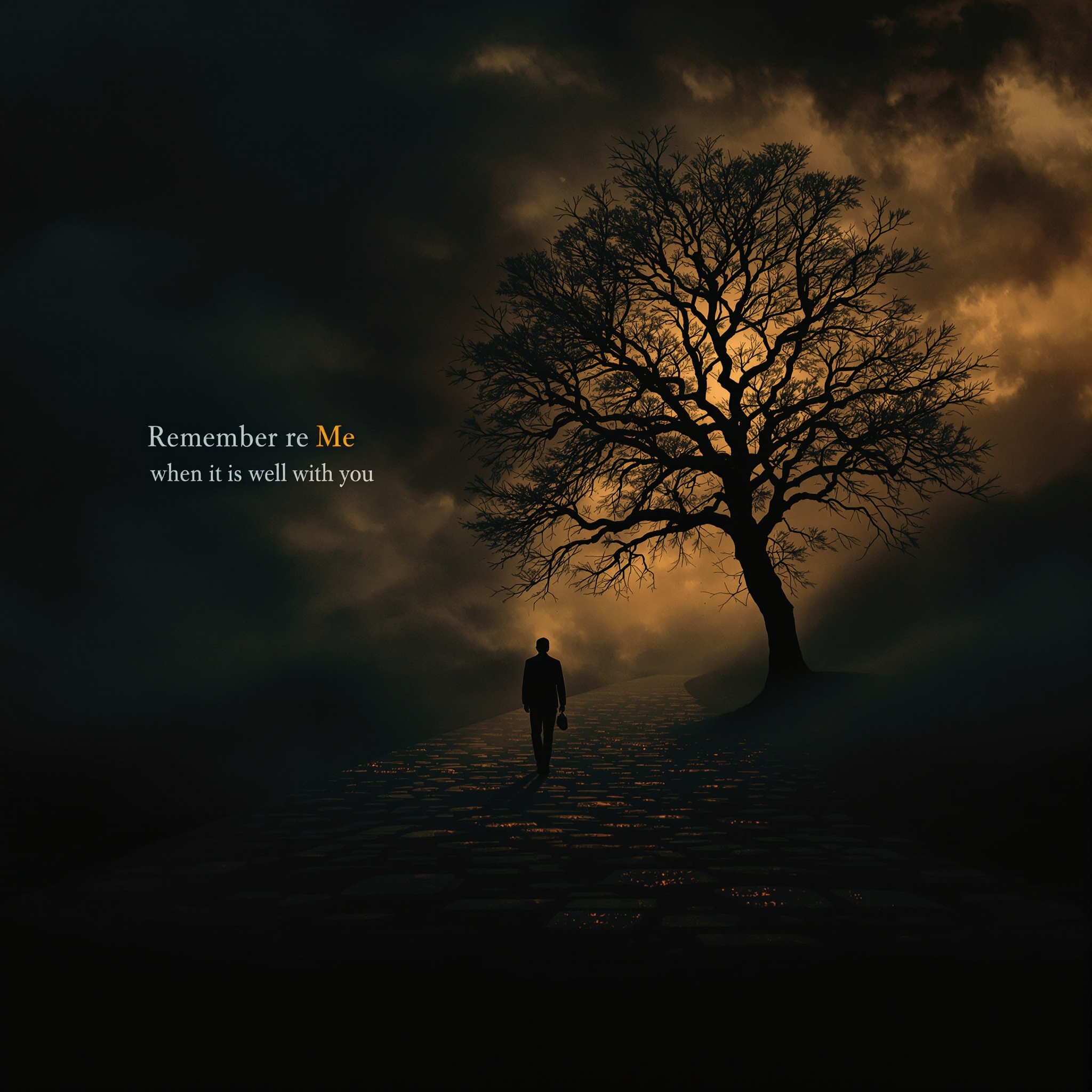
Remember Me When It Is Well With You cover art

Remember Me When It Is Well With You

Intro
Three-note ascending figure on solo string — suspended, unresolved
Verse 1
The stone was warm from his collarbone
where he sat the night I told him what the vine meant —
three branches, and the grapes pressed into Pharaoh’s cup,
and his place restored.
Verse 2
I knew it when I saw it.
I read the three branches like three mornings —
the bud, the blossom,
the cup back in his hand.
I know how mornings turn.
Verse 3 — half-spoken
He said yes
the way men say yes
when they are already
somewhere else.
Refrain
Quiet melodic plea — never full voice
Mention me —
that was all I asked.
A word in the right room,
a word to the right man,
one name
in a palace full of names —
just
mention me.
Verse 4
I have been in a pit before.
The other pit had brothers at the rim
and a circle of sky.
This one has walls
that keep the sky from me.
Spoken
String stills — voice and room air
There is a sound a cell makes
when the person beside you
stands
and does not look back.
The straw forgets them.
I don’t.
Verse 5
I counted the days by the guard’s change.
The third morning I stopped counting —
not because the days stopped,
but because the count
had no place to land.
Verse 6
I gave him the morning
without being asked.
Then I asked.
Refrain
Mention me.
Mention me.
A word is all it takes —
one word in a palace full of words,
one name in a room
that has already moved on —
just
mention me.
Bridge — bare
Slowest passage — each line placed like a stone
I said: remember me.
I meant:
I am owed this.
I meant:
after the coat,
after the pit,
after the chains,
after all the years
that did not open —
let one door
know my name.
Verse 7 — minimal
He said yes
the way a man says yes
when the morning is already his
and the one who gave it
is behind him now.
I am here now.
I am breathing.
Outro
Three-note figure returns beneath the final line — no resolution
Water comes in through the wall
where the mortar has given.
Just a seam.
Just a rising.
The prison is not empty.
The night is not finished.
Remember.

Make this in Suno

Patient prison spiritual, slow 6/8 at 62 BPM. Male lyric tenor, controlled and interior, with a plucked lyre, very low bowed string, and a rare fingertip tap against stone. The REMEMBER ME figure appears twice on the lyre, both times ending suspended. Build gently toward “Mention me,” then withdraw rather than release. The final lines should feel like water finding a crack in the wall.

Paste the style into Suno’s style field and the lyrics above into the lyrics box — the section markers and performance directives are Suno-ready.
19 · Male vocalFull gospel climax / earthen brass
You Meant It for Evil cover art

You Meant It for Evil

Verse 1
He sends them out. Every one.
The Egyptians, the guard, the boy with the ledger —
out, out, all of them, go.
The door shuts.
Eleven men and me.
I am Joseph.
Does my father live?
I am Joseph —
the one you sold into Egypt.
I am Joseph.
Verse 2
You meant it for evil.
I know you meant it for evil.
I watched your faces
when the price came back —
twenty pieces,
and you ate your bread.
I carried that bread in my mouth
for thirteen years.
I am not afraid of you.
Pre-Chorus
Press close.
Press close to me.
I am your brother Joseph —
the one from Canaan,
the one our father weeps for.
Chorus
God sent me before you —
not to make your hands innocent,
not to call the pit a doorway
while I was still down in it.
But to keep breath
inside this famine.
To keep children living.
To keep a house
from disappearing.
You meant it for evil.
God meant it for good.
I do not have to make one disappear
to say the other is true.
Verse 3
I wept so loud Egypt heard me.
Egypt heard me.
The weeping was already out
before I spoke his face into the room.
And you could not answer —
you were troubled before my face.
Bridge — near-spoken
Tell my father.
Tell him:
come down to me.
Do not delay.
Tell him his son is alive.
Tell him the famine will not have him.
Tell him I have room.
Tell him I have bread.
Final Chorus
God meant it for good.
You meant it for evil.
I am not saying it did not wound me.
I am saying it did not end me.
God set me here
before the hunger came
to keep many alive.
Outro
I am Joseph.
I am Joseph.
It is me.

Make this in Suno

Earthen gospel climax, 96 BPM. High baritone lead begins in broken speech, then rises into a full-bodied declaration. Real mixed choir answers only the final phrases of each major chorus; handclaps, skin drums, gut bass, rams’ horns, and low brass build the room around Joseph. At “I am Joseph,” the band drops away before the choir and brass return. Make forgiveness enormous, but never cheap.

Paste the style into Suno’s style field and the lyrics above into the lyrics box — the section markers and performance directives are Suno-ready.
20 · Male vocalDeathbed spiritual / a cappella opening
Carry My Bones cover art

Carry My Bones

Intro - a cappella
Voice alone, close-mic'd, room breath audible — no instruments until marked
I have lived here long enough
to smell the river in my sleep —
not my river.
My river runs north into a land I never reached.
Verse 1 - a cappella
But I have seen it.
The night God gave me pictures
I did not ask for,
I saw the whole of it:
the hunger coming,
the sheaves stacking,
the brothers' faces when they finally saw
who was standing in the storehouse.
I saw all of it
before any of it happened.
Refrain - a cappella
That is not a gift you bear.
That is a gift that bears you.
Verse 2
Single cello enters here — one held note, no vibrato
God will surely come to you —
not to Egypt, where the stone remembers me,
but to the land He swore
to the old man who walked outside to count the stars.
I was there.
I mean I was in him —
the counting was for me
and for my sons
and for sons so far ahead
no word we have can reach them.
Verse 3
Breath-choir enters — four voices, wordless, mouths barely open
God will surely come.
He came to the well before Hagar named it.
He came to the ford where Jacob
folded into morning, limping, renamed.
He has not once
left a thing alone to die
and called it finished.
Verse 4
My years in the pit
were not abandonment.
I know that now
the way you know a scar —
by running your thumb across it
in the dark.
Bridge
Choir swells slightly — the ask
So here is what I ask of you.
Not grief.
Not the burden of what was done —
I have already set it down.
You heard me.
The room went quiet.
I said your names and meant them.
What I ask is this:
my bones.
Verse 5
When God visits you —
and He will —
when the water parts
or the word comes
or the land receives you
and you know
this is the place,
this is the moment,
this is what all of it was for —
take my bones there.
Let me arrive.
Let the man who saw it
be in the ground of it.
Spoken
Do you understand?
This is not a burial request.
This is a wager.
Outro
Choir releasing one voice at a time, cello fading — the last lines nearly alone
The afternoon is ending and I do not mind.
The gift was never mine to keep.
I received it.
I was broken in it.
I was used by it
and I used it back
and in the end
what I hold is this:
the promise, still walking.
Not because I secured it.
Because it endures.
Lay your palm flat here.
Swear it.
The bones know where they are going
even if the man does not.
Take me with you.

Make this in Suno

Deathbed spiritual, through-composed and unmetered. Elder male baritone opens completely a cappella, close enough to hear the room and breath. One bowed gut-string cello enters only at “God will surely come to you.” A low four-voice breath choir arrives later on open vowels, never overpowering the lead. The song grows through the oath, then falls away one voice at a time. End on an open fifth, not a final resolution.

Paste the style into Suno’s style field and the lyrics above into the lyrics box — the section markers and performance directives are Suno-ready.